




Dental Bridge Cost With Insurance: Prices by Bridge Type and What Plans Pay

Reviewed by Russell Noga, Licensed Insurance Broker — Last updated October 27, 2026

With insurance, many people pay about half the cost of a dental bridge, up to their plan’s annual maximum. Bridges are usually covered as a major service, often at around 50% after the deductible, so a $3,000 bridge on a plan with a $1,500 annual maximum could still leave you paying about $1,500 or more.

A dental bridge fills the gap left by one or more missing teeth by attaching a false tooth to the teeth next to it, or to dental implants. Bridges help you chew, speak clearly and keep nearby teeth from shifting. They are also one of the more expensive dental treatments, so it pays to know what your plan will cover before you start.

This guide covers the four main types of bridges, typical prices with and without coverage, waiting periods, the missing tooth clause and ways to lower your bill. For a broader look at how plans handle big-ticket care, see our guide to major services dental insurance.
Compare Dental Plans That Cover Bridges

Dental Bridge Types and What They Cost

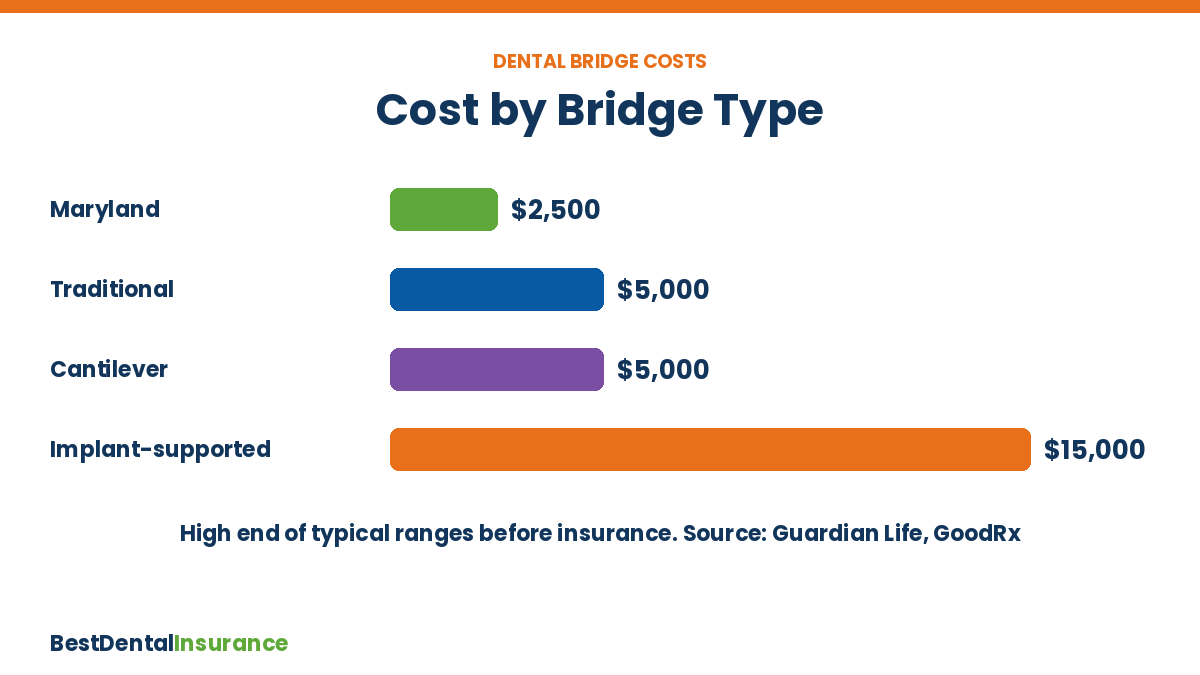
Dental bridge cost with insurance chart showing typical cost by bridge type before insurance

The type of bridge you need is the biggest factor in the price. Your dentist will recommend one based on where the gap is, how many teeth are missing and the health of the teeth around it.

Bridge typeHow it worksTypical cost without insuranceExample you pay with 50% coverage and a $1,500 max
TraditionalFalse tooth held by crowns on the teeth on both sides$2,000 to $5,000About $1,000 to $3,500
CantileverFalse tooth held by a crown on one side only$2,000 to $5,000About $1,000 to $3,500
MarylandFalse tooth bonded to the backs of nearby teeth with a metal or porcelain framework$1,500 to $2,500About $750 to $1,250
Implant-supportedBridge held by dental implants instead of natural teeth$5,000 to $15,000About $3,500 to $13,500, if covered

Source: Guardian Life and GoodRx dental bridge cost guides (costs without insurance). Insured column is a simple math example that ignores the deductible and assumes the bridge is covered; it does not reflect any specific plan. Many plans limit or exclude implants.

Prices vary by your area, your dentist and the materials used. Porcelain, zirconia and metal options can all change the final bill.

Dental Insurance Quotes

Call a Licensed Agent Now

Compare dental plans for individuals, families and seniors from several insurance companies in one call.

☎ 1-833-667-3396

TTY users 711  |  Mon–Fri: 8am–9pm ET

No obligation to enroll

How Dental Insurance Covers Bridges

Most dental plans place bridges in the major services tier, along with crowns, dentures and root canals. Major services are often paid at around 50% after you meet your deductible. Guardian notes that many full-coverage plans may cover 40% to 50% of bridge costs, up to the plan’s annual maximum.

Major-service coinsurance. Often around 50%, so you pay the other half of the plan’s allowed fee.

Deductible first. You usually pay a deductible before the plan starts sharing the cost.

Replacement limits. Some plans only pay for a new bridge on the same tooth once every five years or so.

Implant bridges. Many plans limit or exclude implants, so an implant-supported bridge may get less coverage or none.

Basic plans that cover only cleanings and fillings may not pay for bridges at all. If you think you will need one, look for a plan that clearly lists major services.

Waiting Periods and the Missing Tooth Clause

Two plan rules catch many people off guard when they buy coverage for a bridge. The first is the waiting period. Many individual plans make you wait before they pay for major work, often up to 12 months. Some plans have shorter waits, and some waive them if you had prior dental coverage.

Watch for this: Some plans include a missing tooth clause. If a tooth was already missing before your coverage began, the plan may refuse to pay for a bridge, implant or denture to replace it. If you already have a gap, ask about this clause before you enroll.

Employer plans often have shorter waits or none. Learn more in our guide to dental insurance waiting periods explained.

Annual Maximum Math: A Dental Bridge Cost Example

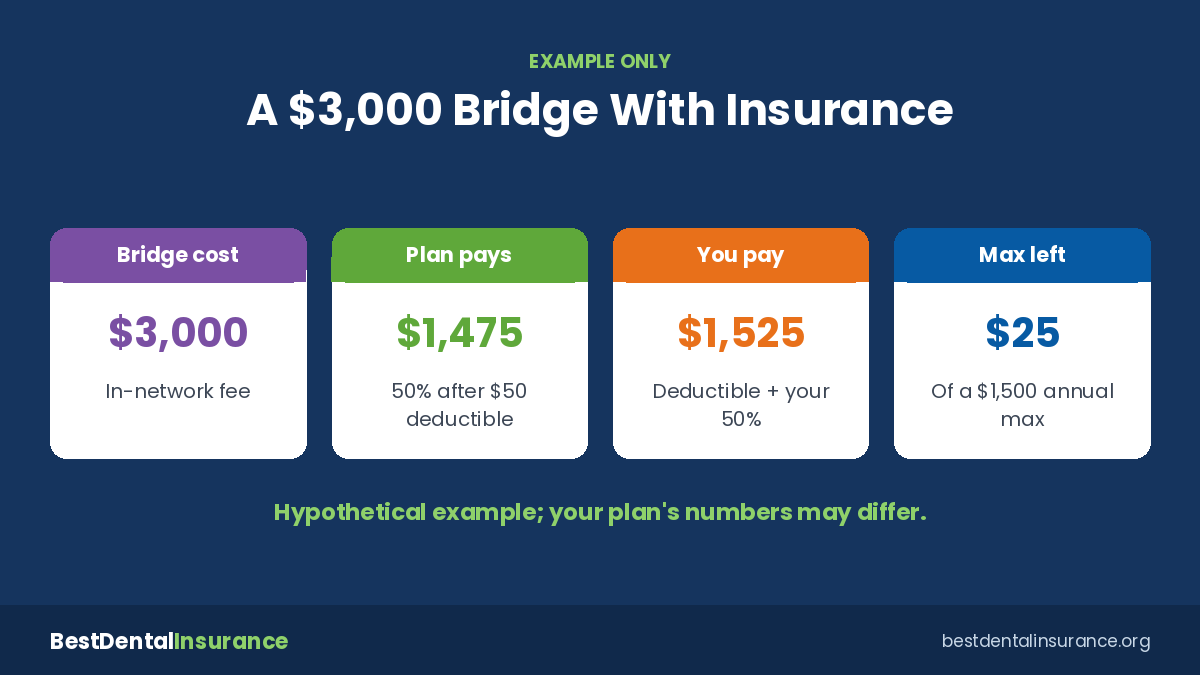
Dental bridge cost with insurance example with 50 percent coinsurance and a 1500 dollar annual maximum

Your annual maximum is the most your plan will pay in a plan year. Many plans set it somewhere around $1,000 to $2,000. With a bridge, that cap often matters more than the coinsurance percentage.

1

Start with the bill. Say your three-unit traditional bridge costs $3,000 at an in-network dentist.

2

Pay the deductible. With a $50 deductible, $2,950 is left to share.

3

Apply 50% coinsurance. The plan’s share is $1,475, which fits under a $1,500 annual maximum.

4

Add up your share. You pay the $50 deductible plus $1,475, for a total of about $1,525.

This is only an example. If you already used part of your maximum on fillings or crowns that year, the plan would pay less. Our guide to annual maximum vs lifetime maximums explains how these caps work.

Find & Compare Plans Online

Speak with a licensed insurance agent

1-833-667-3396TTY 711

Mon-Fri: 8am-9pm ET

Dental Bridge vs Implant vs Partial Denture

A bridge is not the only way to replace a missing tooth. The right choice depends on your budget, your bone and gum health, and how long you want the fix to last.

OptionGood to knowHow insurance often treats it
Dental bridgeFixed in place; may require reshaping nearby teeth for crownsMajor service, often around 50%
Single dental implantDoes not rely on nearby teeth; usually costs more up frontCovered by some plans as a major service; many limit or exclude it
Removable partial dentureOften the lowest-cost option; can be taken outMajor service, often around 50%

Coverage varies by plan and state. Check your plan’s limitations and exclusions.

Compare options in our guides to dental implant coverage and whether dental insurance covers dentures.

How to Lower Your Dental Bridge Cost

Get a pre-treatment estimate. Ask your dentist to send the plan to your insurer so you see your share before work starts.

Stay in network. Network dentists charge plan-negotiated fees, which lowers both the bill and your 50%.

Split treatment across plan years. If your dentist says it is safe, starting work late in one plan year and finishing in the next can use two annual maximums.

Look at discount plans and HSAs. A dental discount plan may cut fees with no waiting period, and HSA or FSA dollars can pay your share pre-tax.

For more ideas, see 8 alternative ways to pay for major dental work on a budget.

Bottom Line

A dental bridge often costs $1,500 to $5,000 or more without insurance, and a plan that covers major services may pay about half, up to its annual maximum. Watch for waiting periods and missing tooth clauses, and get a pre-treatment estimate before you start.

Related: tooth crown cost with insurance Crown prices by material, what plans pay and how to lower your share.

See dental plans & rates in your ZIP code

Dental Bridge Cost With Insurance — Frequently Asked Questions

➤ How much does a dental bridge cost with insurance?

Many plans pay around 50% of a bridge after the deductible, up to the annual maximum. On a $3,000 bridge with a $1,500 maximum, you might pay about $1,500 or more, depending on your plan.

➤ How much does a dental bridge cost without insurance?

Guardian and GoodRx list traditional and cantilever bridges at about $2,000 to $5,000, Maryland bridges at about $1,500 to $2,500 and implant-supported bridges at about $5,000 to $15,000 or more.

➤ Is a dental bridge a major service?

Usually, yes. Most dental plans group bridges with crowns, dentures and root canals as major services, which are often covered at around 50%.

➤ Is there a waiting period for a dental bridge?

Often, yes. Many individual plans have a waiting period for major services, sometimes up to 12 months. Some plans have shorter waits or waive them with proof of prior coverage.

➤ What is a missing tooth clause?

It is a rule in some plans that won’t pay to replace a tooth that was already missing before your coverage started. If you already have a gap, ask whether a plan has this clause before you buy it.

➤ Does dental insurance cover implant-supported bridges?

Some plans do, usually as a major service, but many limit or exclude implants. Even when covered, the annual maximum often leaves a large balance.

➤ Is a bridge cheaper than an implant?

A traditional bridge often costs less up front than an implant, and it is more often covered by dental insurance. An implant does not rely on nearby teeth, though, so ask your dentist which fits your situation.

➤ How can I lower my dental bridge cost?

Use an in-network dentist, get a pre-treatment estimate, and plan around your annual maximum. A dental discount plan or HSA or FSA dollars can also help.

Dental Insurance Quotes

Call a Licensed Agent Now

Compare dental plans for individuals, families and seniors from several insurance companies in one call.

☎ 1-833-667-3396

TTY users 711  |  Mon–Fri: 8am–9pm ET

No obligation to enroll

Find & Compare Plans Online

Speak with a licensed insurance agent

1-833-667-3396TTY 711

Mon-Fri: 8am-9pm ET

ZRN Health & Financial Services, LLC, a Texas limited liability company