



Dental Implant Cost With Insurance: The Out-of-Pocket Math for One Tooth

Reviewed by Russell Noga, Licensed Insurance Broker — Last updated November 9, 2026

With dental insurance, one dental implant priced around $4,500 often still leaves you paying roughly $2,500 to $3,500, because most plans that cover implants pay about 50% and then stop at an annual maximum of about $1,000 to $2,000. If your plan excludes implants, pays only a cheaper alternate benefit or has a missing tooth clause, your share can be close to the full price.

2027 by the Numbers

$3,000-$7,000

typical price of one implant with post, abutment and crown (GoodRx)

$4,200

average single implant cost without insurance (ValuePenguin, Aspen Dental data)

About 50%

share full-coverage plans often pay for major procedures (GoodRx)

A dental implant replaces one missing tooth from the root up: a post goes into the jawbone, an abutment connects to it, and a crown sits on top. It lasts a long time and costs a lot, so the real question is how much of the bill lands on you after your plan pays.

This page sticks to the dollars: what one implant costs, how your plan’s percentage and yearly cap interact, which rules shrink the payout, and six worked examples. If you are still checking whether a plan covers implants at all, start with do any dental insurance plans cover implants.
Compare Dental Plans That Help With Implants

What One Implant Costs Before Any Plan Pays

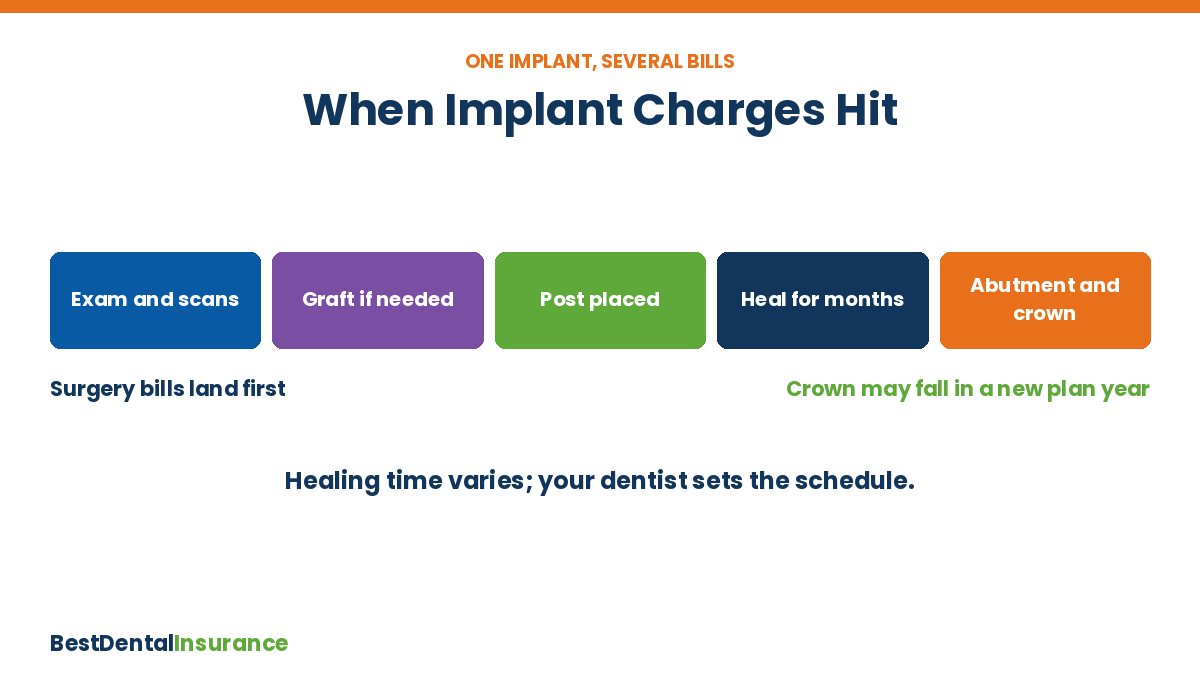
Dental implant cost with insurance timeline showing when each implant phase is billed

An implant is a series of visits spread over several months, and each step can show up as its own line on the bill. Prices depend on your city, the dentist or oral surgeon, the implant material and whether your jaw needs extra work first.

Cost itemWhen it appliesCommonly cited price
Full single implant (post, abutment and crown)Every case$3,000 to $7,000 (GoodRx); average about $4,200 (ValuePenguin, Aspen Dental data)
Exam, X-rays and planning visitBefore surgery$200 to $450 if uninsured (GoodRx)
Bone graftOnly if the jawbone is too thinAbout $600 on average (GoodRx, Authority Dental data)
Sinus liftSome upper back teeth$1,500 to $2,500 (GoodRx, Authority Dental data)
SedationIf you choose or need it$50 to $200 for sedation (GoodRx, Authority Dental data)

National figures published by the sources named, not quotes. Many plans exclude grafts and sinus lifts even when they pay toward the implant.

Replacing a whole arch, such as All-on-4, is a much larger cost; this page covers one tooth.

Dental Insurance Quotes

Call a Licensed Agent Now

Compare dental plans for individuals, families and seniors from several insurance companies in one call.

☎ 1-833-667-3396

TTY users 711  |  Mon–Fri: 8am–9pm ET

No obligation to enroll

How the Plan Splits a Major-Service Bill

When a plan does cover implants, it almost always lists them as major work. Three numbers then decide your share, and they apply in a fixed order.

The deductible comes off the top. You pay this yearly amount yourself before the plan shares anything.

Coinsurance splits what is left. Major services are often paid at about 50% of the plan’s allowed fee, so you owe the other half.

The annual maximum stops the plan. Once the plan has paid its yearly cap, often $1,000 to $2,000, every dollar after that is yours.

On a $4,500 implant, half of the bill is about $2,225 after a $50 deductible. That is more than many plans can pay in a year, so for implants the cap usually matters more than the percentage. The difference between a yearly and a lifetime cap is covered in annual maximum vs lifetime maximums in dental plans.

Policy Rules That Shrink the Implant Payout

Even a plan that lists implants as covered can pay less than you expect. Look in the limitations and exclusions section of the plan booklet.

Waiting period. Many individual plans pay nothing for major work during the first 6 to 12 months. Group plans often have shorter waits or none.

Missing tooth clause. Some plans refuse to replace a tooth that was already missing on the day coverage began, even after the waiting period ends.

Frequency limits. Plans often limit how often they replace the same tooth.

Plan language to look for: An alternate benefit, or least expensive alternative treatment, clause lets the plan pay only for a cheaper option that would also fix the problem. The BCBS FEP dental program states that implant services may be alternated to a partial or full denture, and Delta Dental’s dentist guidelines say its standard plans pay an allowance or alternate benefit toward implant-supported crowns and bridges. You can still choose the implant, but you owe the difference.

Delta Dental’s guidelines also say implant placement is not considered for teeth that were congenitally missing, meaning they never grew in. If that describes your gap, ask before you enroll. Waits are covered in dental insurance waiting periods explained.

Six Plan Setups, One $4,500 Implant: Our Calculation

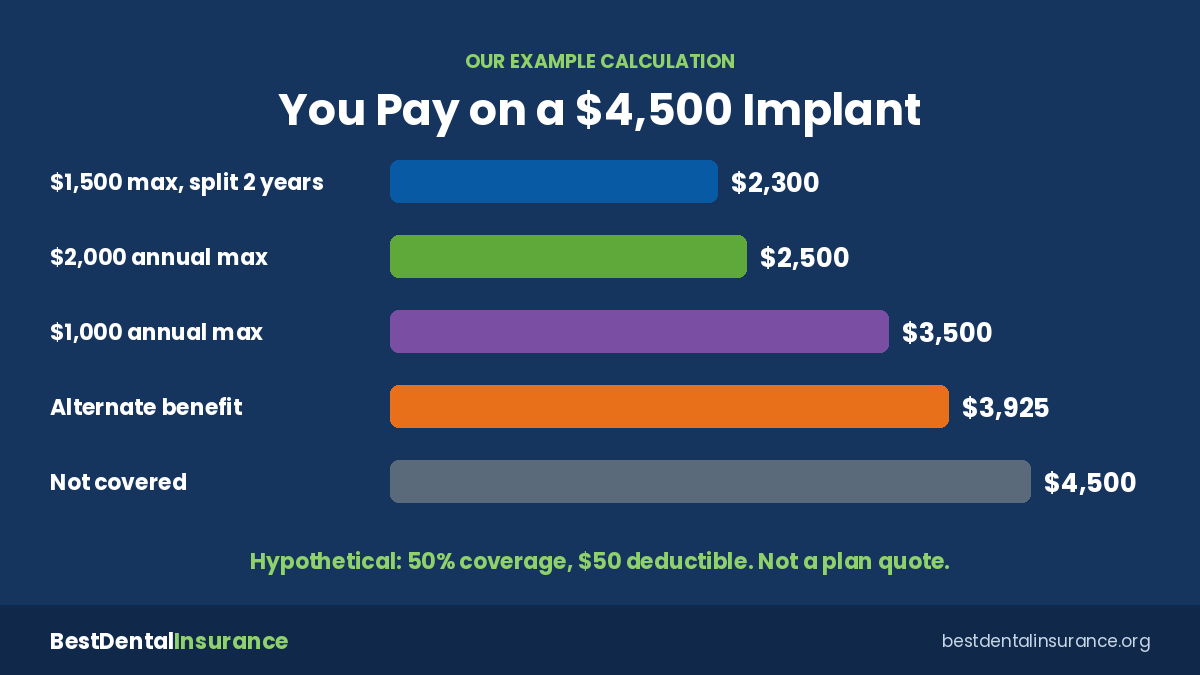
Dental implant cost with insurance chart comparing out-of-pocket cost on a 4500 dollar implant by plan setup

To show how much the plan design changes your bill, we ran the same implant through six setups. Assumptions: a $4,500 in-network fee for post, abutment and crown, a $50 deductible, 50% coinsurance for major services, no other claims that year and any waiting period already served.

Plan setupPlan paysYou pay
50% coverage, $2,000 annual maximum$2,000 (50% would be $2,225, cap hit)$2,500
50% coverage, $1,500 annual maximum$1,500 (cap hit)$3,000
50% coverage, $1,000 annual maximum$1,000 (cap hit)$3,500
$1,500 maximum, treatment split over two plan years ($2,500 surgery in year one, $2,000 crown in year two)$1,225 + $975 = $2,200$2,300 (two deductibles)
Alternate benefit paid at an assumed $1,200 denture allowance$575$3,925
Implants excluded or missing tooth clause applies$0$4,500

Our example calculation from the stated assumptions; not a quote from any plan. The $1,200 denture allowance and the $2,500/$2,000 phase split are illustrative numbers. Real allowed fees, deductibles and caps vary by plan and state.

Raising the yearly cap from $1,000 to $2,000 saves $1,000 on this one tooth. And when your dentist agrees the timing is safe, letting the healing gap cross into a new plan year unlocks a second maximum.

Find & Compare Plans Online

Speak with a licensed insurance agent

1-833-667-3396TTY 711

Mon-Fri: 8am-9pm ET

Reading Your Pre-Treatment Estimate Line by Line

Before surgery, ask the office for a pre-treatment estimate, also called a predetermination. Implants are billed with separate procedure codes, so the estimate shows which pieces the plan will pay.

1

Find the post. Code D6010 is surgical placement of the implant body. A zero here often means the plan pays toward the crown only.

2

Find the connector. D6056 or D6057 is a stock or custom abutment; some offices bundle it into the crown fee.

3

Find the crown. Codes such as D6058 or D6065 are implant crowns. An allowed amount that looks like a denture or bridge fee signals an alternate benefit.

4

Compare to the cap. Add the plan’s share, including any graft or extraction lines, and check it against what is left of your annual maximum.

An estimate is not a payment guarantee, but it turns a percentage into dollar amounts.

Other Ways to Pay: Medical Coverage, Medicare and Tax-Free Money

Medical insurance. Health plans rarely pay for implants. Exceptions can include tooth loss from an accident or from cancer treatment, and even then the plan may cover only the surgical part.

Medicare. Original Medicare excludes virtually all routine dental care, including implants. Some Medicare Advantage plans include dental benefits with their own caps, so implant help varies by plan.

HSA or FSA dollars. IRS Publication 502 lets you pay for dental treatment and artificial teeth with pre-tax funds, while purely cosmetic work is excluded. Confirm with your account administrator before paying.

Dental discount plans. These are not insurance. You pay a reduced fee at participating dentists, usually with no annual maximum and no waiting period.

Good to know: Insurance and a discount plan can sometimes work together on an implant, but only if the dentist and both plans allow it. Ask the office before treatment starts.

For plan features that matter most when an implant is likely, see our guide to dental implant coverage insurance, and for seniors, are dental implants covered by Medicare.

Bottom Line

One dental implant commonly costs $3,000 to $7,000, and insurance that covers it usually pays about half until the annual maximum runs out, so many people still owe $2,500 or more. Check the waiting period, missing tooth clause and alternate benefit wording, then get a pre-treatment estimate that lists each code before surgery.

Check implant-friendly dental plans in your ZIP code

Dental Implant Cost With Insurance — Frequently Asked Questions

➤ What is the out-of-pocket cost of a dental implant with insurance?

In our example of a $4,500 implant with 50% coverage and a $50 deductible, you pay $2,500 to $3,500 depending on whether the annual maximum is $2,000, $1,500 or $1,000. Your plan’s allowed fee and remaining cap set the real number.

➤ Why does my plan pay so little toward an implant?

Usually the annual maximum runs out before the 50% share is reached. An alternate benefit clause, which pays the price of a denture or bridge instead, can also lower the payout.

➤ Does insurance pay for the implant post or just the crown?

It depends on the plan. Some pay toward every piece, while others pay toward the crown but not the surgical post. The codes on a pre-treatment estimate show which parts are covered.

➤ Can I split implant treatment across two plan years?

Often, yes. Healing between the post and the crown commonly takes months, so the crown may fall in the next plan year and use a fresh annual maximum. Your dentist decides if the timing is safe.

➤ Will a new plan cover a tooth I lost before I enrolled?

Not if the plan has a missing tooth clause. Read the exclusions or ask the insurer before you buy if you already have a gap.

➤ Are bone grafts covered when I get an implant?

Many plans exclude grafts and sinus lifts or treat them separately. GoodRx puts the average bone graft at about $600, which may be fully yours.

➤ Can I pay for an implant with my HSA or FSA?

Generally, yes. IRS rules allow pre-tax funds for dental treatment that is not purely cosmetic, and replacing a missing tooth usually qualifies. Check with your account administrator.

➤ Does Medicare help with the cost of a dental implant?

Original Medicare does not cover implants. Some Medicare Advantage plans include dental benefits that may help, but coverage and yearly caps differ by plan.

Dental Insurance Quotes

Call a Licensed Agent Now

Compare dental plans for individuals, families and seniors from several insurance companies in one call.

☎ 1-833-667-3396

TTY users 711  |  Mon–Fri: 8am–9pm ET

No obligation to enroll

Find & Compare Plans Online

Speak with a licensed insurance agent

1-833-667-3396TTY 711

Mon-Fri: 8am-9pm ET

ZRN Health & Financial Services, LLC, a Texas limited liability company