



Small Business Dental Insurance: Group Plan Rules, Costs and Carriers

Reviewed by Russell Noga, Licensed Insurance Broker — Last updated November 10, 2026

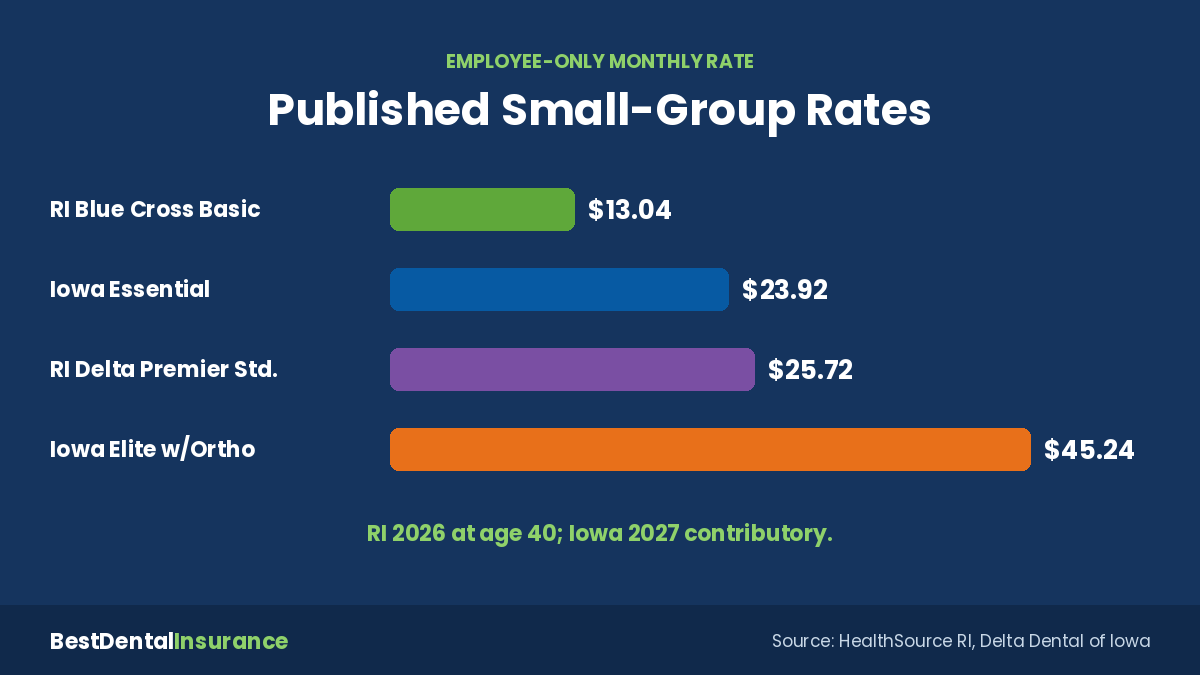
Small business dental insurance is a group dental plan an employer buys for its workers, and many carriers will write one for as few as two enrolled employees. Plans the employer helps pay for usually need more workers to sign up than voluntary ones, and published small-group rates run from about $13 to $51 a month for employee-only coverage.

2027 by the Numbers

2

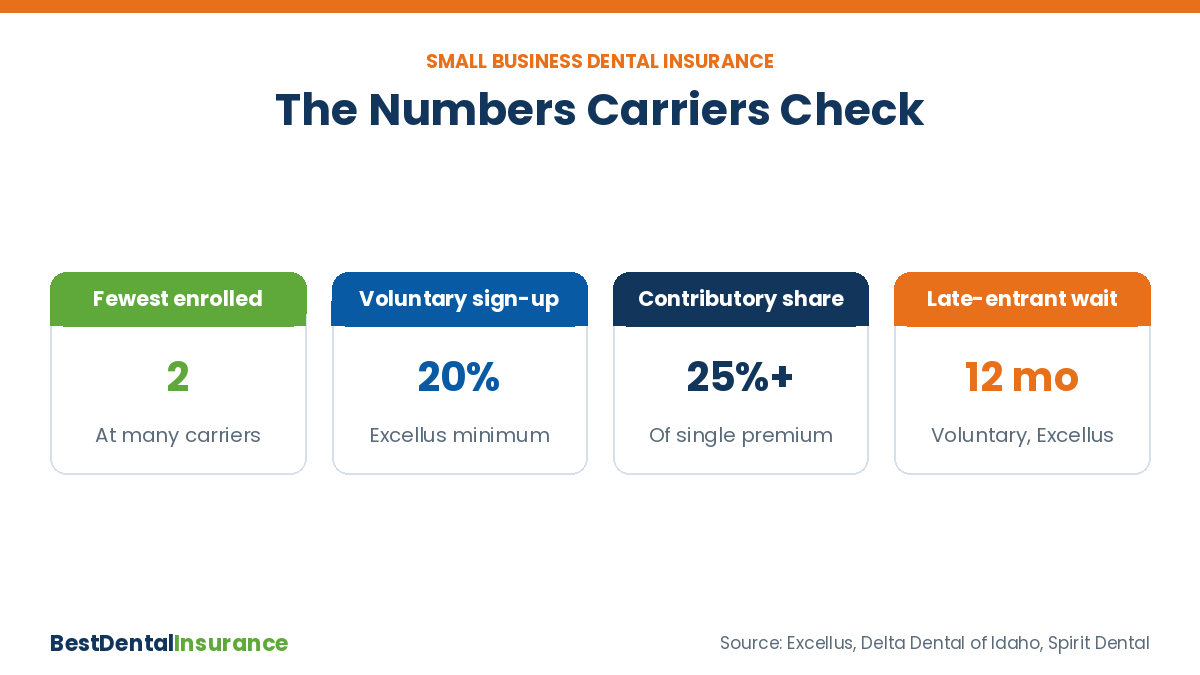
fewest enrolled employees needed at carriers such as Delta Dental of Idaho and Spirit Dental (carrier sites)

$23.92

lowest 2027 employee-only monthly rate on Delta Dental of Iowa’s small-business rate sheet

50%

top Small Business Health Care Tax Credit, as a share of employer premiums (IRS)

Group dental has its own rules. Carriers decide how many workers must enroll, how much the owner has to pay in, and what happens to people who join late.

This guide is for owners shopping for a plan and workers deciding whether to join. It puts several carriers’ rules in one table and shows real filed rates. For coverage for a solo owner, see dental insurance for business owners.
Compare Dental Plans in Your Area

How a Small-Group Dental Plan Works

Small business dental insurance thresholds from carrier underwriting rules

The employer signs one master policy with a dental carrier. Each eligible worker then enrolls or waives, and can usually add a spouse and children. Premiums reach the carrier through the company. Carriers often treat 2 to 50 or 2 to 100 employees as a small group.

Dental PPO. Members can see any licensed dentist but pay less in network. Premiums run higher, and a yearly benefit maximum applies.

Dental HMO (DHMO). Members pick a primary dentist from a smaller network and pay set copays. Out-of-network care is generally not covered except emergencies, and many DHMOs have no yearly maximum.

Indemnity plan. The plan pays a share of the dentist’s charge for covered care, with no network required. That freedom can come with higher premiums.

Coverage is often written as three numbers, such as 100-80-50, for preventive, basic and major care. See dental HMO vs. PPO plans for the network trade-offs.

Dental Insurance Quotes

Call a Licensed Agent Now

Compare dental plans for individuals, families and seniors from several insurance companies in one call.

☎ 1-833-667-3396

TTY users 711  |  Mon–Fri: 8am–9pm ET

No obligation to enroll

Enrollment and Contribution Rules, Carrier by Carrier

Each carrier sets its own minimums, and few shoppers see them in one place. We pulled these rules from each carrier’s own site or underwriting guide.

Carrier (area)Smallest groupSign-up minimumEmployer share
Delta Dental of Idaho2-50 employees2 enrolled or 35% of eligible, whichever is greaterNot required; contributing can lower rates
Delta Dental of Washington2 enrolledEmployer-paid, 2-9 workers: 100% of eligible. Voluntary, 2-9 workers: 2 enrolledRules differ for employer-paid vs. voluntary plans
Delta Dental of Minnesota2-100 employeesMeet participation rules; workers usually need 20+ hours a weekNo minimum; under 50% is typically treated as voluntary
Excellus BlueCross BlueShield (NY)2 enrolled contractsContributory: 50% of eligible. Voluntary: 20% of eligibleContributory needs 25%+ of the single premium
Moda Health (Oregon, dental only)5 enrolled75% of employees and 75% of dependents50% of employee premium
Spirit Dental2 employeesNot published on its siteNot published; some options have no waiting periods

Sources: carrier small-group web pages and underwriting guides reviewed November 2026 (Delta Dental of Washington guide dated 2021; Moda guide is for Oregon small employers). Rules change and vary by state, so confirm with the carrier.

Underwriting detail: Workers who waive because they have other group coverage, Medicare, Medicaid or TRICARE usually do not count against participation at Moda Health. Workers who waive for an individual plan do count against it.

Employer-Paid, Shared Cost or Voluntary

The biggest choice an owner makes is how much of the premium to cover. It drives the sign-up rules and often the price.

Employer-paid. The company covers all or most of each worker’s premium. Carriers expect high enrollment, up to 100% of eligible workers in very small groups.

Shared cost (contributory). The company pays a set share, often at least 25% to 50% of the employee-only premium, and workers pay the rest through payroll.

Voluntary. Workers pay the full premium, but get group pricing and payroll deduction. Sign-up minimums are lower, sometimes just two people.

Employer money tends to buy a lower rate, because more healthy workers enroll instead of only those who need dental work soon. On Delta Dental of Iowa’s 2027 rate sheet, the Essential plan costs $23.92 a month for employee-only coverage on a contributory basis versus $26.34 when voluntary. Contributory rates there require 10 or more eligible employees.

Voluntary plans can carry a catch. Excellus applies a 12-month wait to late entrants for some basic and major services on voluntary plans. Read more on dental insurance waiting periods.

What Group Dental Costs Per Employee

Small business dental insurance employee-only monthly rates from Rhode Island SHOP and Delta Dental of Iowa

Few carriers post small-group prices, but some exchanges and carriers do. These are full monthly premiums before any employer share.

Plan (state, year)Employee only, per monthNotes
Blue Cross Dental Basic (Rhode Island SHOP, 2026)$13.04Age 40; $18.03 at age 60
Delta Dental Premier Standard (Rhode Island SHOP, 2026)$25.72Age 40; $30.14 at age 60
Delta Dental of Iowa Essential (2027)$23.92 / $26.34Contributory / voluntary
Delta Dental of Iowa Elite w/Ortho (2027)$45.24 / $50.54Contributory / voluntary; family $147.20 / $165.24
Delta Dental of Iowa Prestige w/Ortho (2027)$49.02 / $51.02Healthy Smiles; contributory / voluntary

Sources: HealthSource RI 2026 small-group dental rate sheet; Delta Dental of Iowa 2027 small-business rates, subject to Iowa Insurance Division approval. Your rates depend on state, group size, plan design and who enrolls.

Adding a spouse roughly doubles the premium, and family coverage on the Iowa sheet runs more than three times the employee-only rate. Rhode Island’s rates also rise with age. Compare the average cost for dental insurance bought on your own.

Find & Compare Plans Online

Speak with a licensed insurance agent

1-833-667-3396TTY 711

Mon-Fri: 8am-9pm ET

Tax Rules and Alternatives to a Group Plan

The IRS says a business can generally deduct employee benefit program costs, including accident and health plans. Employer payments toward such a plan are generally left out of workers’ taxable wages, and workers can often pay their share pre-tax through a cafeteria plan. Owners of more than 2% of an S corporation follow different rules.

SHOP Marketplace. For employers with 1 to 50 full-time equivalent workers. It sells separate dental plans, and a business can enroll any time of year.

Small business tax credit. Up to 50% of employer premiums for two years, but tied to SHOP qualified health plans, firms under 25 full-time equivalents and at least a 50% employer share. Whether dental counts is a question for a tax pro.

QSEHRA. Firms under 50 full-time equivalents with no group health plan can reimburse workers’ own premiums, dental included. Workers need qualifying health coverage; 2026 caps are $6,450 self-only and $13,100 family.

ICHRA. Any size employer, but workers must have individual health insurance. A separate group dental plan can sit beside it.

Payroll note: A QSEHRA is only allowed when the company offers no group health plan, so a business that adds group medical later loses the QSEHRA option.

Setting Up a Group Dental Plan in Six Steps

1

Count eligible workers. Set who qualifies, such as 20+ hours a week, and any wait for new hires.

2

Choose a funding model. Employer-paid, shared cost or voluntary, checked against each carrier’s minimums.

3

Pick a plan design. PPO, DHMO or indemnity, plus the yearly maximum, deductible and orthodontics.

4

Quote more than one carrier. Compare rates by tier, nearby network dentists and late-entrant rules.

5

Collect enrollments and waivers. Signed waivers often decide whether the group meets participation.

6

Set up payroll and billing. The company sends one premium a month. Guardian says setup can take about two weeks.

Workers without a plan at work can buy coverage on their own; see individual dental insurance.

Bottom Line

Small business dental insurance is within reach for companies with as few as two workers, but the rules for sign-ups and employer share vary widely by carrier. Paying part of the premium usually lowers the rate and protects workers from late-entrant waits, while voluntary plans cost the company nothing. Compare several carriers’ rules and filed rates before you sign.

Related: Lincoln dental insurance plans and the DentalConnect network How Lincoln Financial’s employer dental plans, DHMO states and MaxRewards rollover work.

See group and individual dental rates in your ZIP code

Small Business Dental Insurance — Frequently Asked Questions

➤ How many employees do I need for a group dental plan?

Many carriers start at two enrolled employees, including Delta Dental of Idaho and Spirit Dental. Others set the floor higher; Moda Health requires five enrolled for stand-alone dental in Oregon.

➤ Does the employer have to pay part of the premium?

Not always. Delta Dental of Minnesota and Delta Dental of Idaho have no minimum employer share. Other carriers require one for contributory plans, such as 25% of the single premium at Excellus or 50% at Moda Health.

➤ Is a group dental plan a tax write-off for the business?

Generally yes. The IRS says businesses can generally deduct employee benefit program costs, and employer payments are generally not taxed as worker wages. S corporation owners with more than 2% have special rules.

➤ Can part-time workers be covered?

It depends on the carrier and the employer’s rules. Delta Dental of Minnesota, for example, usually requires at least 20 hours of work a week, and seasonal or temporary workers are usually not eligible.

➤ What if too few employees sign up?

The carrier may decline the group or offer only a voluntary plan with a lower minimum. Workers who waive because they have other group coverage often do not count against it.

➤ Can I offer dental without offering health insurance?

Yes. Carriers sell stand-alone group dental, and the SHOP Marketplace sells separate dental plans. A QSEHRA can also reimburse dental premiums, but workers must have their own qualifying health coverage.

➤ Do group dental plans have waiting periods?

Some do and some do not. Spirit Dental offers options with no waiting periods, while Excellus applies a 12-month wait to late entrants on voluntary plans for some basic and major services.

➤ Can workers add a spouse and children?

Yes, most plans offer employee, employee plus spouse, employee plus children and family tiers. Some employer-paid plans require a share of eligible dependents to enroll too; Delta Dental of Washington’s guide sets that at 50%.

Dental Insurance Quotes

Call a Licensed Agent Now

Compare dental plans for individuals, families and seniors from several insurance companies in one call.

☎ 1-833-667-3396

TTY users 711  |  Mon–Fri: 8am–9pm ET

No obligation to enroll

Find & Compare Plans Online

Speak with a licensed insurance agent

1-833-667-3396TTY 711

Mon-Fri: 8am-9pm ET

ZRN Health & Financial Services, LLC, a Texas limited liability company