




Does Dental Insurance Cover Invisalign? Clear Aligner Costs, Limits and Payouts

Reviewed by Russell Noga, Licensed Insurance Broker — Last updated November 1, 2026

Yes, dental insurance covers Invisalign when your plan includes orthodontic benefits, because most insurers pay for clear aligners the same way they pay for braces. Expect the plan to pay a share of the fee up to a lifetime orthodontic cap, such as the $1,000 cap on Cigna Dental 1500, while plans without orthodontics pay nothing toward aligners.

2027 by the Numbers

$3,500-$9,500

typical adult Invisalign Comprehensive fee range (GoodRx, citing Authority Dental)

$1,000

Cigna Dental 1500 lifetime orthodontia maximum, Invisalign included (Cigna)

$1,200

Spirit Dental Pinnacle PPO lifetime maximum for child orthodontics (Spirit Dental)

Invisalign is a brand of clear plastic aligners that move teeth a little at a time. To an insurer, it is orthodontic treatment. So the real question is whether your plan has an orthodontic benefit, who on the policy can use it, and how much of it is left.

Below: aligner costs, carrier terms, payout timing, at-home kits and tax-free accounts. For the basics of the benefit itself, see our guide to orthodontic coverage in dental insurance.
Compare Dental Plans With Orthodontic Benefits

What Invisalign Costs Before Insurance Pays

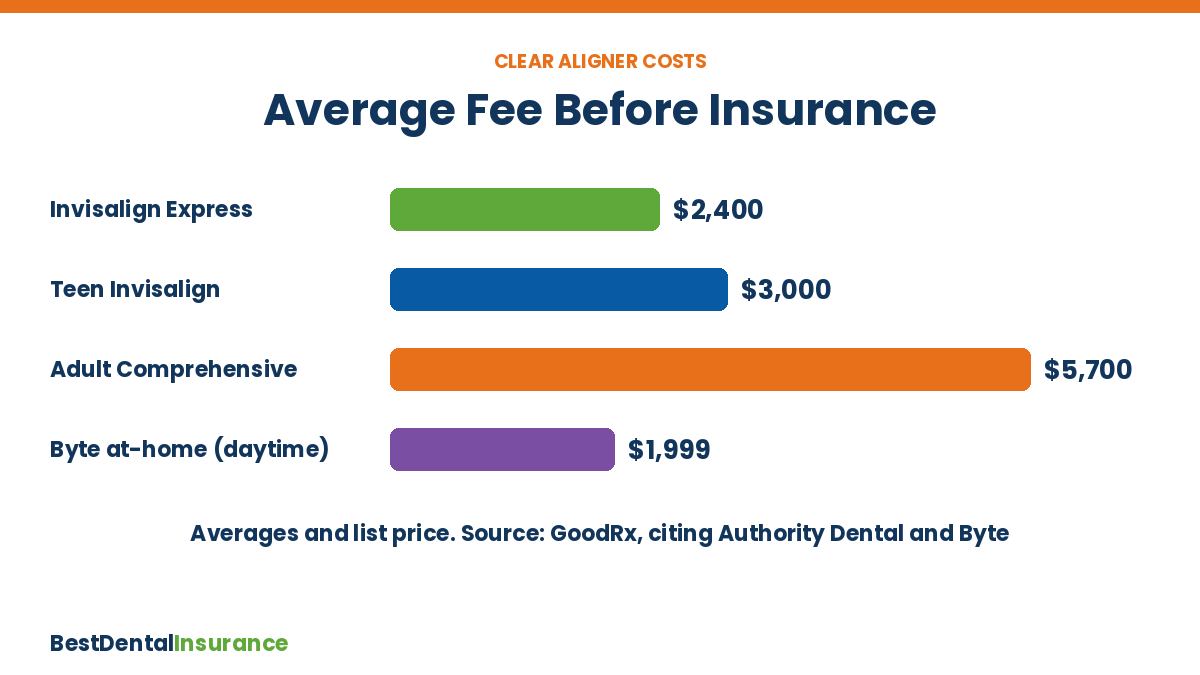
Does dental insurance cover Invisalign chart of average clear aligner costs before insurance

Your orthodontist sets the Invisalign fee, and it climbs with how far your teeth need to move. GoodRx, citing Authority Dental, reports these ranges:

Treatment typeTypical fee rangeReported average
Invisalign Express (minor fixes)$1,800 to $3,000About $2,400
Teen treatment$2,000 to $5,000About $3,000
Adult Invisalign Comprehensive$3,500 to $9,500About $5,700
Byte at-home aligners (list price)$1,999 daytime, $2,399 nighttimeFixed price

Source: GoodRx Invisalign cost guide, citing Authority Dental; Byte prices as listed by GoodRx from Byte’s pricing page. Your quote depends on your case, provider and area.

Quick math: In a GoodRx example, a $5,700 adult case under Cigna Dental 1500, which pays up to $1,000 for orthodontia, leaves the patient owing about $4,700. The lifetime cap, not the percentage, is what limits the payout.

Invisalign’s own site says insurance may help cover up to $3,000 of orthodontic treatment. It cites OrthoFi data from 2021 showing an average of $1,772 in coverage among more than 112,000 insured U.S. patients.

Dental Insurance Quotes

Call a Licensed Agent Now

Compare dental plans for individuals, families and seniors from several insurance companies in one call.

☎ 1-833-667-3396

TTY users 711  |  Mon–Fri: 8am–9pm ET

No obligation to enroll

Clear Aligner Terms by Carrier: Our Side-by-Side Look

No single source lines these up, so we pulled orthodontic terms from each carrier’s own plan pages and benefit summaries. Where a cell says not stated, the carrier did not say, which is not the same as no.

Carrier and planWho can use orthoAligners named?Ortho limit and shareOrtho wait
Cigna Dental 1500 (individual)Check policy for age rulesYes, Invisalign listed$1,000 lifetime; 50% after a separate lifetime deductible12 months
Delta Dental PPO Premium and DeltaCare USA (individual)Adults included on these plans, per Delta DentalYes, a standard benefit on many plans with adult orthoVaries by plan and stateVaries; PPO individual plans have waits for major care
Spirit Dental Pinnacle PPOChildren under 19Not stated$1,200 lifetime; pays 10% year 1, 25% year 2, 50% year 3None for child ortho
Humana Family Dental PPO (2026)Children up to age 19; adults not coveredNot stated50% after deductible; see certificate for limitsNone listed for child ortho
Ameritas PrimeStar BoostChildren under 19Not statedNot stated on plan pageNo waits in most states

Our comparison of carrier plan pages and benefit summaries (Cigna, Delta Dental Insurance Company, Spirit Dental, Humana, Ameritas). Terms change and vary by state. Confirm in the policy before treatment.

Most individual plans with orthodontics stop at age 19, so adults usually need an employer plan or a carrier that names adult orthodontics. Our page on Delta Dental orthodontics coverage goes deeper on that carrier.

Teens, Adults and Seniors: Who Gets Aligner Coverage

Teens. Many family plans pay a dependent’s orthodontics until a set age, often 19 on the plans in our table.

Working-age adults. Coverage usually comes through work or a richer individual tier. Delta Dental says adult orthodontics is offered on its PPO and DeltaCare USA group plans and its PPO Premium individual plan.

Seniors on Medicare. Original Medicare does not cover most routine dental care, so it does not pay for aligners. Medicare Advantage dental benefits vary by plan; if orthodontics is not listed in the Evidence of Coverage, it is not covered.

Most plans treat aligners as orthodontic care when they fix bite or spacing problems, but GoodRx notes some plans classify them as cosmetic and exclude them. Adults comparing options can read our guide to the best dental insurance for adult braces, and seniors can see the limits of dental coverage under Medicare.

How the Orthodontic Benefit Is Paid Out Over Your Treatment

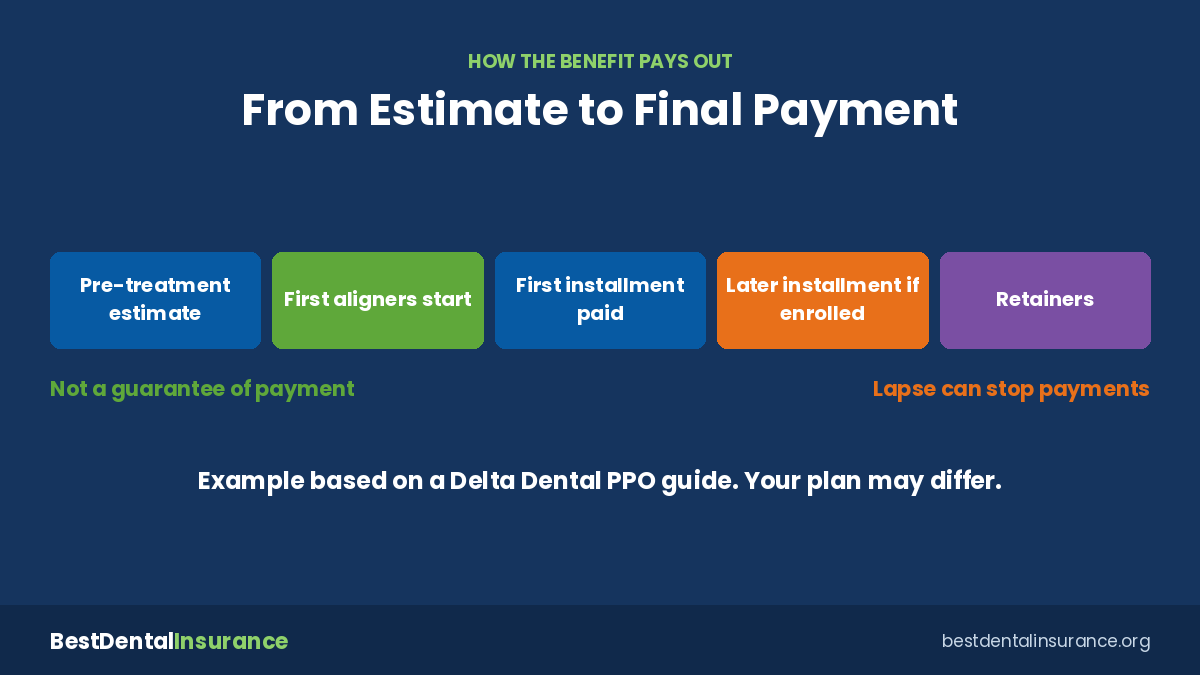
How dental insurance pays the Invisalign orthodontic benefit over time

Insurers rarely pay the whole orthodontic benefit on day one. One Delta Dental orthodontic guide for PPO plans spells it out: treatment under $500 is paid in one lump sum once treatment starts, and larger cases are paid in two installments, one at the start and one 12 months later.

Stay enrolled. The same Delta Dental guide says that under some plans you may lose eligibility if coverage lapses more than 30 or 60 days. A later installment may never arrive.

Watch both caps. Whether ortho payments also count against the yearly maximum depends on the plan. See annual vs. lifetime maximums.

Retainers. Delta Dental says most of its plans with orthodontics cover one set of post-treatment retainers.

Worth knowing: The office’s payment plan and the insurer’s payout schedule are separate. You may owe a down payment and monthly installments while the insurer pays on its own timeline.

Find & Compare Plans Online

Speak with a licensed insurance agent

1-833-667-3396TTY 711

Mon-Fri: 8am-9pm ET

At-Home Aligners, FSAs and HSAs

Mail-order aligners skip most office visits, which is why they cost less. A plan pays only if the aligner company or its dentist bills the plan or is in network. In 2020, Guardian announced byte as an in-network provider for its members with orthodontic coverage.

Company risk. SmileDirectClub shut down in December 2023 after filing for bankruptcy, leaving customers mid-treatment. Paying in installments instead of all up front limits what is at stake.

FSA and HSA dollars. IRS Publication 502 lists braces among dental treatments that count as medical expenses, while teeth whitening does not count. Invisalign says FSA and HSA funds can be used for its treatment.

Pair the accounts with insurance. Use tax-free dollars for the share your plan does not pay. An HSA requires a high-deductible health plan.

Your FSA administrator sets how orthodontic claims are reimbursed, so ask before prepaying a large fee.

Getting Pre-Approval Before Your First Tray

1

Ask for a pre-treatment estimate. The office sends your plan the treatment plan and fee. Delta Dental notes an estimate is not a guarantee of final payment.

2

Confirm the aligner wording. Look for “clear aligners” or “Invisalign” in the orthodontic section and “cosmetic” in the exclusions.

3

Check what is left of the lifetime cap. If a past round of braces used part of it, only the remainder is available.

4

Line up the start date. Start after any orthodontic waiting period ends, since payouts are tied to when treatment begins.

5

Coordinate a second plan. If two plans cover you, both may pay up to their own limits. Our guide to secondary dental insurance for orthodontics explains the order.

Bottom Line

Dental insurance pays for Invisalign only when the plan has an orthodontic benefit, and then usually up to a lifetime cap that is far below the full aligner fee. Check who on your policy qualifies, get a pre-treatment estimate, stay enrolled until every installment is paid, and use FSA or HSA money for the rest.

Check plans that pay toward clear aligners in your ZIP code

Invisalign and Dental Insurance — Frequently Asked Questions

➤ Is Invisalign covered the same as metal braces?

On most plans with orthodontic benefits, yes. Delta Dental calls Invisalign a standard benefit on many of its plans with adult orthodontics, though a few plans treat aligners as cosmetic.

➤ How much will insurance pay toward Invisalign?

It depends on your plan’s share and its lifetime orthodontic cap. Cigna Dental 1500, for example, pays up to $1,000 per lifetime for orthodontia including Invisalign. Invisalign cites 2021 OrthoFi data showing an average of $1,772 in coverage for insured patients.

➤ Can adults get Invisalign through insurance?

Yes, but adult coverage is less common. Many individual plans limit orthodontics to children under 19. Employer plans and some richer individual tiers, such as Delta Dental’s PPO Premium, include adult orthodontics.

➤ Does my plan pay the Invisalign benefit all at once?

Usually not. Many plans pay in installments tied to treatment starting and to you staying enrolled. One Delta Dental PPO guide pays cases over $500 in two parts, at the start and 12 months later.

➤ Does insurance cover at-home aligners like Byte?

Only if your plan covers orthodontics and the aligner provider can bill it or is in network. Guardian made byte an in-network provider for members with orthodontic coverage in 2020.

➤ Can I use an FSA or HSA for Invisalign?

Yes, in most cases. IRS Publication 502 counts braces as a qualified dental expense, and Invisalign says FSA and HSA funds can pay for its treatment. Purely cosmetic work like whitening does not qualify.

➤ Does Medicare pay for Invisalign?

Original Medicare does not cover most routine dental care, including aligners. Some Medicare Advantage plans include dental benefits, but orthodontics is covered only if the plan’s Evidence of Coverage lists it.

➤ What happens if I drop my plan in the middle of Invisalign?

Later installments may stop. Delta Dental notes that under some plans, eligibility can end if coverage lapses more than 30 or 60 days.

Dental Insurance Quotes

Call a Licensed Agent Now

Compare dental plans for individuals, families and seniors from several insurance companies in one call.

☎ 1-833-667-3396

TTY users 711  |  Mon–Fri: 8am–9pm ET

No obligation to enroll

Find & Compare Plans Online

Speak with a licensed insurance agent

1-833-667-3396TTY 711

Mon-Fri: 8am-9pm ET

ZRN Health & Financial Services, LLC, a Texas limited liability company