




Secondary Dental Insurance: How Two Dental Plans Split One Bill

Reviewed by Russell Noga, Licensed Insurance Broker — Last updated November 11, 2026

Secondary dental insurance is a second dental plan that pays after your primary plan, picking up some or all of the balance the first plan leaves, but never more than the dentist’s allowed fee. It usually comes from a spouse’s or second employer’s group plan, and how much it adds depends on its coordination clause, its own annual maximum and its waiting periods.

2027 by the Numbers

100%

most two plans together can pay of the allowable expense (NAIC COB model rule)

2 = 2

two plans that each cover two cleanings a year still cover two, not four (Delta Dental of New Jersey)

Group only

coordination of benefits applies between group plans; an individual plan pays as primary (Delta Dental)

Two dental plans often happen by accident: both spouses enroll at work, a child sits on two parents’ policies, or a retiree keeps an old employer plan. The carriers then follow coordination of benefits (COB) rules that decide who pays first and how much the other adds.

Below are those rules for adults, kids and people on Medicare, one crown bill run through each payment method, and how to file. For braces, see secondary dental insurance for orthodontics.
Compare Dental Plans in Your Area

How a Primary and a Secondary Dental Plan Share a Claim

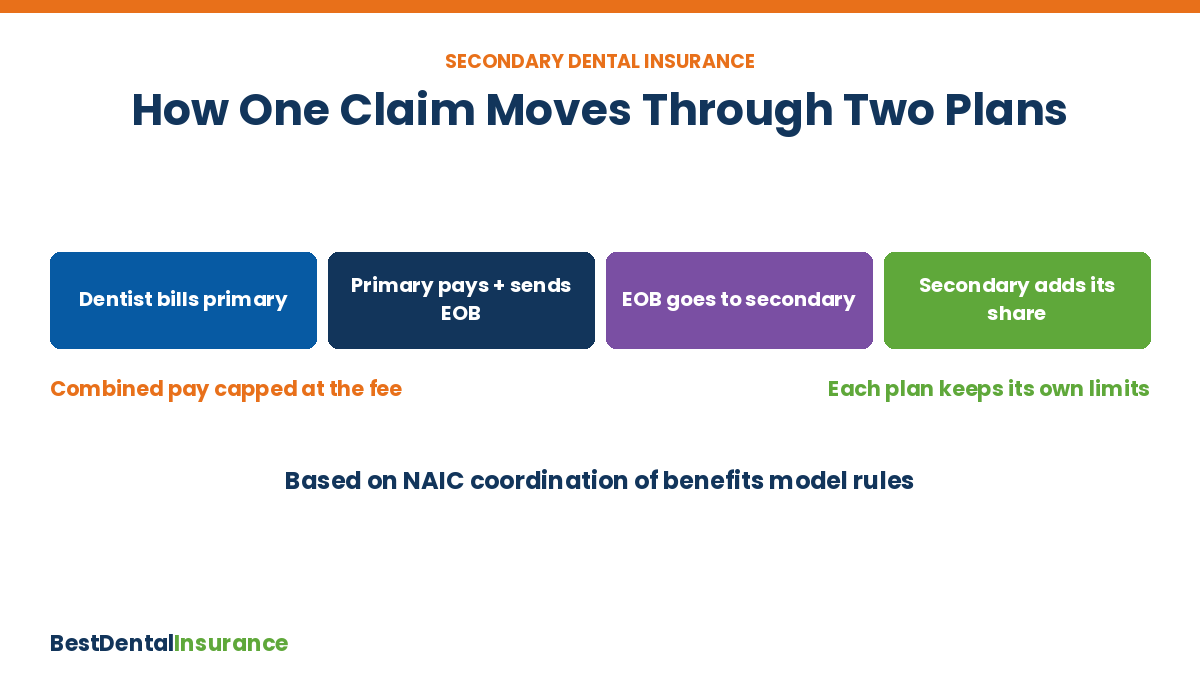
Secondary dental insurance claim flow from primary plan to secondary plan

The primary plan handles the claim as if no other coverage existed, then sends an explanation of benefits (EOB). The secondary plan reads that EOB and decides what to add toward the unpaid amount.

One fee, two payers. The NAIC model rule many states use caps combined benefits at 100% of the allowable expense.

Separate rulebooks. Each plan keeps its own deductible, coverage percentages, network and waiting periods.

Limits do not double. If both plans allow two cleanings a year, you still get two covered cleanings.

Two plans help most on fillings, root canals and crowns, which are often paid at 70% to 80% or 50% rather than in full.

Dental Insurance Quotes

Call a Licensed Agent Now

Compare dental plans for individuals, families and seniors from several insurance companies in one call.

☎ 1-833-667-3396

TTY users 711  |  Mon–Fri: 8am–9pm ET

No obligation to enroll

Which Plan Pays First: The Order of Benefit Rules

Most states base dental COB rules on the National Association of Insurance Commissioners (NAIC) model regulation. Each plan uses the first rule that fits, then stops.

SituationPays firstPays second
You are the employee on one plan and a dependent on the otherPlan that covers you as the employee or policyholderPlan that covers you as a spouse or dependent
Child on both parents’ plans, parents married or sharing custodyParent whose birthday (month and day) comes first in the calendar yearOther parent’s plan; if birthdays match, the plan that has covered the child longer goes first
Child of divorced or separated parentsPlan named in a court decree, if the plan knows of itWithout a decree: custodial parent, then that parent’s spouse, then the other parent, then that parent’s spouse
Active job vs. retiree or laid-off coveragePlan from the current jobRetiree or laid-off employee plan
Active or retiree plan vs. COBRA or state continuationEmployer or retiree planCOBRA or continuation coverage
Two jobs, none of the above settles itPlan that has covered you longerNewer plan

Source: NAIC Coordination of Benefits Model Regulation (Model 120), order of benefit determination rules. States adopt their own versions, and some group plans write in extra terms, so the plan certificate controls.

Worth knowing: The birthday rule ignores the year. A parent born in March 1990 is primary over a parent born in July 1980, because only the date on the calendar counts.

Group Plans, Individual Plans and Medicare Advantage Dental

COB is mainly a group-plan system. Delta Dental’s broker guidance says group plans coordinate only with other group plans, an individual plan always pays as primary, and two individual plans each pay as primary. Humana’s guide also says dual coverage applies to group plans, not individual ones.

Two employer plans. The order rules above apply, and the secondary plan’s coordination clause sets how much it adds.

Employer plan plus an individual plan. Under those carrier rules, the individual policy pays first and the group plan may coordinate on the rest. Terms vary by carrier and state.

Medicare Advantage dental plus a separate policy. Medicare Advantage dental benefits vary by plan and are not employer group coverage. Ask each carrier which pays first before major work.

Original Medicare only. It does not cover most routine dental care, so there is usually nothing for a dental plan to coordinate with.

Seniors can compare options in our guide to supplemental dental insurance for Medicare.

Standard COB, Non-Duplication and Maintenance of Benefits Compared

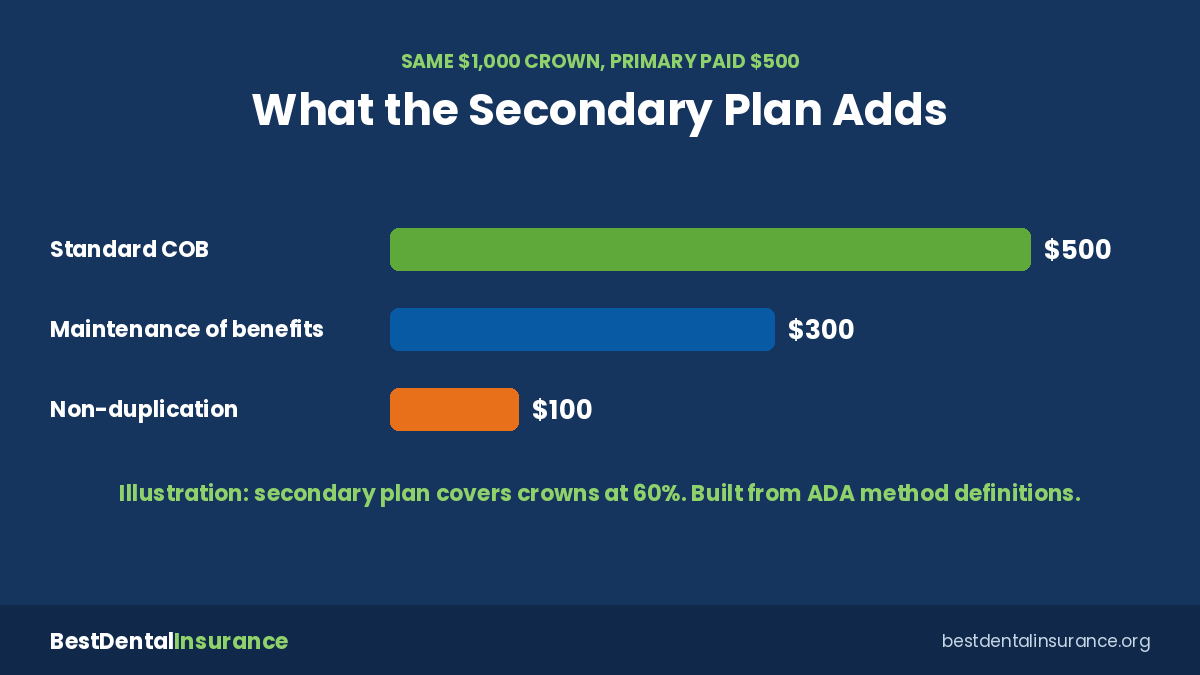
Secondary dental insurance payment on a $1,000 crown under standard COB, maintenance of benefits and non-duplication

The secondary plan’s coordination clause matters more than its premium. Here is one crown run through the methods the American Dental Association (ADA) describes: a $1,000 allowed fee, deductibles met, maximums not reached, a primary plan paying 50% ($500) and a secondary plan that pays 60% on crowns when it is primary.

Method used by the secondary planHow it figures its paymentSecondary paysYou pay
Standard (traditional) COBIts normal benefit ($600) or the unpaid balance ($500), whichever is less$500$0
Maintenance of benefitsIts 60% applied to what the primary left unpaid: 60% of $500$300$200
Non-duplication or carve-outIts normal benefit ($600) minus what the primary paid ($500)$100$400
Non-duplication, plans swapped (60% plan is primary)Primary paid $600, more than the 50% plan’s normal $500$0$400

Illustration built from the ADA’s definitions of each method and the NAIC 100% cap. Real payments also depend on network fees, frequency limits and each plan’s own terms. Carriers sometimes use the terms carve-out and non-duplication interchangeably.

The ADA says non-duplication is typically used in self-funded employer plans, opposes it, and notes California has prohibited it. With a non-duplication secondary and matching coverage levels, a second premium may buy very little.

Find & Compare Plans Online

Speak with a licensed insurance agent

1-833-667-3396TTY 711

Mon-Fri: 8am-9pm ET

Annual Maximums, Deductibles and Waiting Periods on Two Plans

Because each plan keeps its own limits, a second plan can widen what is available in a heavy treatment year.

1

Two separate maximums. What the secondary pays counts against its own annual maximum, so it may keep paying after the primary hits its cap. See annual vs. lifetime maximums.

2

Deductible credit. Under the NAIC model, the secondary credits its deductible as it would have with no other coverage.

3

Waiting periods run per plan. A new secondary plan still waiting on major care generally adds nothing to a crown until that period ends. See dental insurance waiting periods.

4

Networks can clash. A dentist may be in-network for one plan only. Fees above a plan’s allowance stay with you, and HMO-style plans complicate coordination.

Is a Second Dental Plan Worth Paying For, and How to File

Add up a year of the second premium, then estimate what it would add on the work you expect, using the table above. With only checkups ahead, it rarely pays back, since cleanings do not double and preventive care is often covered in full already. A year with crowns or a root canal is where a standard-COB secondary plan can cut the bill sharply.

1

Give the office both cards. Delta Dental tells members to report all coverage before treatment and warns that failing to do so could be considered insurance fraud.

2

Confirm the order. Ask which plan is primary for each family member; kids may differ from parents.

3

Bill the primary first. The secondary generally will not process the claim until the primary has paid.

4

Send the secondary the primary EOB. Attach it to the claim form, and watch the secondary’s filing deadline.

Family note: A child’s primary plan is set by the birthday rule, not by which parent added the child first. See dental insurance for kids.

Bottom Line

Secondary dental insurance pays after your primary plan and can close much of the gap on fillings and crowns, but it never doubles cleanings or pays more than the allowed fee. Before paying a second premium, find out which plan is primary, which coordination method the secondary uses, and whether its waiting periods and maximum will let it pay in the year you need care.

Check dental plans and prices for your ZIP code

Secondary Dental Insurance — Frequently Asked Questions

➤ Can I buy secondary dental insurance on my own?

You can buy a second individual policy, but carriers such as Delta Dental say individual plans pay as primary rather than coordinating. Its waiting periods still apply.

➤ If my spouse and I each have work dental, who is primary for me?

Your own employer’s plan pays first for you and your spouse’s plan pays second. It runs in reverse for your spouse.

➤ How does the birthday rule work if both parents share a birthday?

Under the NAIC model rule, the plan that has covered the child longer pays first. Birth year is never used.

➤ Does COBRA dental pay first or second?

If you also have active, retiree or dependent coverage under such a plan, that plan pays first and COBRA pays second.

➤ Will two plans pay 100% of my dental bill?

Sometimes, under standard coordination. With a non-duplication or maintenance-of-benefits clause you usually still owe part of the bill.

➤ Does a secondary plan have its own annual maximum?

Yes. Each plan tracks its own yearly maximum, and secondary payments count only against the secondary’s cap.

➤ Do I have to tell my dentist about both plans?

Yes. Report every plan before treatment so the office bills them in the right order; leaving one out can hold up the claim.

➤ Is it ever better to drop the second plan?

It can be, if it uses non-duplication with coverage equal to or below your primary, or you only expect preventive care. Compare a year of premium with what it would really add.

Dental Insurance Quotes

Call a Licensed Agent Now

Compare dental plans for individuals, families and seniors from several insurance companies in one call.

☎ 1-833-667-3396

TTY users 711  |  Mon–Fri: 8am–9pm ET

No obligation to enroll

Find & Compare Plans Online

Speak with a licensed insurance agent

1-833-667-3396TTY 711

Mon-Fri: 8am-9pm ET

ZRN Health & Financial Services, LLC, a Texas limited liability company