




Does Dental Insurance Cover Teeth Whitening? Exceptions, Codes and Real Costs

Reviewed by Russell Noga, Licensed Insurance Broker — Last updated November 7, 2026

No, most dental insurance does not cover teeth whitening, because insurers classify it as a cosmetic service. A few individual plans are exceptions, such as Humana Bright Plus with a $100 yearly in-office whitening allowance, and some plans may consider bleaching a single tooth darkened after a root canal or injury.

2027 by the Numbers

$100

yearly in-office whitening allowance on Humana Bright Plus individual plans (Humana plan summaries)

50%

whitening coinsurance on some Delta Dental of New Jersey individual plans (Delta Dental of NJ)

$583

national average for Zoom in-office whitening (CareCredit, 2024 Synchrony cost study)

Whitening lightens the natural color of your teeth with a peroxide gel. Your dentist can do it in the chair, hand you custom trays to use at home, or you can buy strips at the drugstore. To an insurance company, though, a whiter smile is a change in looks, not a fix for disease, and that single label decides almost every claim.

This guide explains where that rule bends, the four billing codes dental offices use for bleaching, which plans actually pay something, and how to stretch your own money. Cosmetic care is one of the common dental insurance exclusions, so start by checking your plan’s exclusions list.
Compare Dental Plans With Cosmetic Extras

Why Insurers Call Whitening Cosmetic

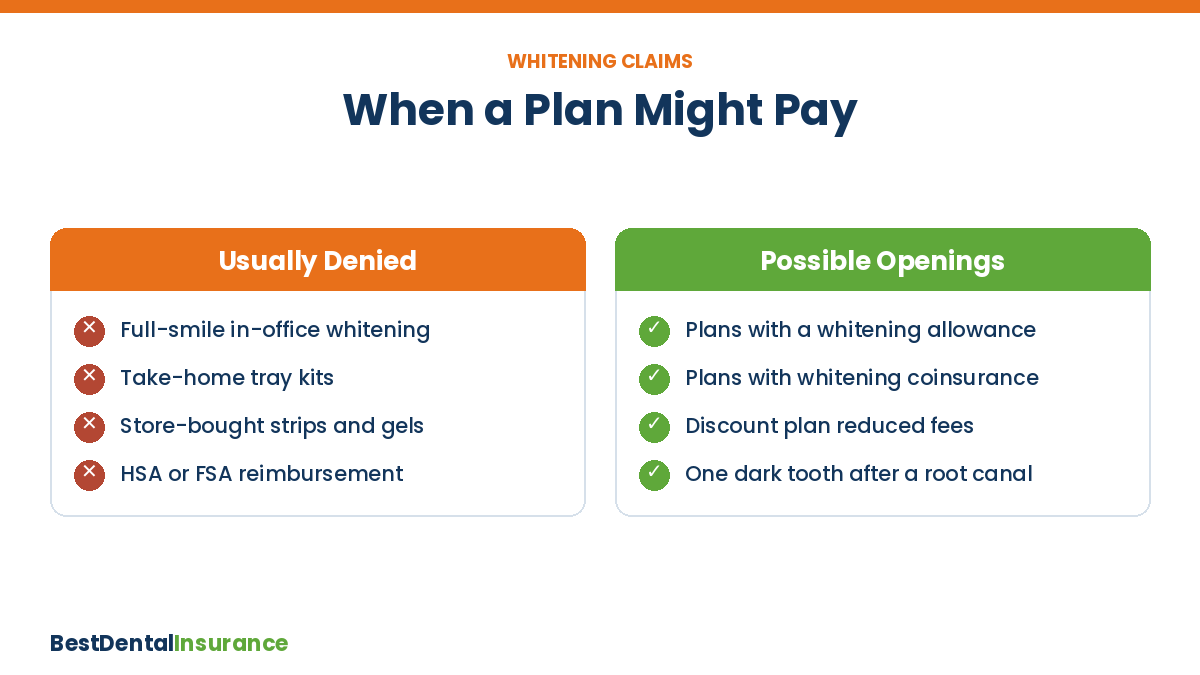
Does dental insurance cover teeth whitening comparison of usually denied and sometimes paid cases

Dental plans are built to pay for care that prevents or treats disease. Stains from coffee, tea, red wine, tobacco or aging do not harm the tooth, so plans list whitening with other appearance-only work, whether the policy covers one adult, a family or a retiree. Delta Dental of Ohio puts it plainly on its member FAQ: cosmetic procedures such as tooth whitening are not covered under its individual dental plans.

Usually denied. Whitening a full smile with in-office gel, custom trays or a laser session to brighten healthy teeth.

Sometimes reviewed. Bleaching one non-vital tooth that turned dark after a root canal or an injury. Plans differ, and many still call it cosmetic.

Paid as a perk. A small number of individual plans add a fixed whitening allowance or a coinsurance share on purpose, as a selling point.

Dental Insurance Quotes

Call a Licensed Agent Now

Compare dental plans for individuals, families and seniors from several insurance companies in one call.

☎ 1-833-667-3396

TTY users 711  |  Mon–Fri: 8am–9pm ET

No obligation to enroll

The Four Bleaching Codes and How Plans Treat Them

Dental offices bill whitening with codes from the ADA’s CDT code set, and the code tells you whether a claim has any chance. The last column shows the median negotiated rate PayorMap found in insurers’ federal price-transparency files. A negotiated rate is an agreed fee, not proof the plan pays.

CDT codeWhat it billsTypical plan treatmentMedian negotiated rate
D9972External bleaching, per arch, done in the officeCosmetic; excluded on most plans$288 per arch
D9973External bleaching, per toothCosmetic; excluded on most plans$30 per tooth
D9974Internal bleaching, per tooth (a non-vital tooth, usually after a root canal)Often still cosmetic; some plans review it with records$180 per tooth
D9975External bleaching for home use, per arch, with dentist-made traysCosmetic; excluded on most plans$50 per arch

Our comparison. Code uses per ADA CDT categories; rates are PayorMap national medians from CMS Transparency in Coverage files, March 2026 refresh. Rates vary widely by state and network and are not quotes.

Coding note: D9974 applies to a tooth that no longer has a living nerve. It is not meant for whitening several healthy teeth. A claim for it has the best chance when the chart and X-rays show the root canal or injury that caused the darkening.

Plans That Pay Something Toward Whitening

Most carriers exclude whitening, so the exceptions are worth knowing by name. We checked carrier plan documents and discount plan pages; benefits vary by state and change yearly.

PlanWhitening benefitKey conditions
Humana Bright Plus (individual)$100 allowance once per calendar yearMust be done in the office by a dentist; deductible and waiting periods do not apply (Illinois and Texas summaries)
Delta Dental of New Jersey individual plans (Classic, Enhanced Plus Ortho, Premium)50% coinsuranceA 12-month waiting period may apply, per the carrier’s 2025 plan sheet
Delta Dental of Ohio individual plansNot coveredListed as a cosmetic exclusion
Careington Care 500 Series (discount plan, not insurance)Whitening named among cosmetic services offered at reduced feesPlan-wide savings of 20% to 60%; no separate whitening price published

Sources: Humana Bright Plus plan summaries; Delta Dental of New Jersey whitening page and 2025 individual plan sheet; Delta Dental of Ohio member FAQ; Careington. Confirm availability in your state.

A discount plan can make sense if whitening is your main goal, because there are no claims to deny. You pay a membership fee and then a reduced price at a participating dentist. Our guide to dental insurance vs. dental discount plans explains the trade-offs.

What Whitening Costs When You Pay Yourself

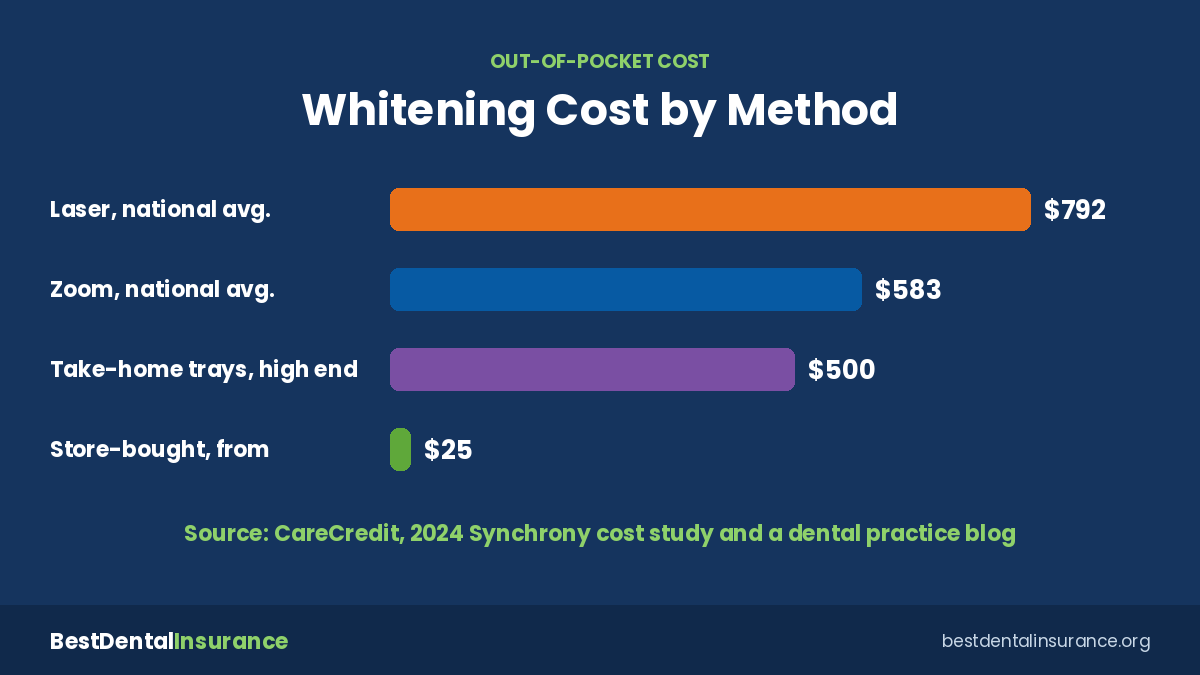
Teeth whitening cost by method chart for people whose dental insurance does not cover teeth whitening

Since most people pay the full bill, price matters more than coverage. CareCredit’s figures come from a 2024 Synchrony cost study it commissioned, plus a dental practice blog for home options, so treat them as rough guides.

MethodReported costSource
Laser whitening in the office$611 to $1,368; national average $7922024 Synchrony cost study
Zoom in-office whitening$463 to $1,011; national average $5832024 Synchrony cost study
Dentist-made take-home trays$375 to $500Dental practice blog cited by CareCredit
Store-bought strips, gels and toothpaste$25 and upDental practice blog cited by CareCredit

As reported by CareCredit (November 2024). Laser averages ranged by state from $679 in West Virginia to $1,129 in Hawaii.

Quick math: On a Zoom visit near the $583 national average, a $100 Bright Plus allowance cuts the bill to about $483. On a plan that pays 50%, the same visit would cost about $292, before any deductible and as long as the annual maximum still has room.

Find & Compare Plans Online

Speak with a licensed insurance agent

1-833-667-3396TTY 711

Mon-Fri: 8am-9pm ET

HSA, FSA and Tax Rules for Whitening

Health savings accounts and flexible spending accounts follow the IRS definition of medical care, and whitening falls outside it.

IRS Publication 502. The 2025 edition lists teeth whitening under expenses you cannot include, and points readers to its cosmetic surgery rule.

A long-standing position. In a May 2003 news release, the IRS said treating tooth discoloration does not promote the proper function of the body and is not a deductible medical expense.

Publication 502 lets cosmetic work count when it corrects a deformity from a birth defect, an injury or a disfiguring disease. Whether a dark tooth after an accident meets that bar is a question for your administrator or tax advisor before you swipe the card. The root canal itself does qualify as dental treatment, and our page on whether Delta Dental covers root canals covers that side of the bill.

Before You Book: A Whitening Checklist

1

Get a checkup first. The Illinois Department of Public Health advises an exam before at-home whitening, since bleach will not remove stain from cavities or leaking fillings and may worsen decay. Exams are usually covered as preventive care.

2

Remember restorations stay the same shade. Bleach works only on natural teeth. Crowns, implants and tooth-colored fillings keep their color, so ask your dentist about timing if new dental work is planned. Our guide to dental insurance that covers veneers looks at the other main cosmetic option.

3

Ask which code the office will bill. D9974 for one non-vital tooth is a different claim from D9972 for a full arch. Request a pre-treatment estimate if you hope the plan will pay.

4

Time any allowance. A calendar-year allowance resets each January, so one visit late in the year and one early in the next can use two allowances.

5

Check Medicare separately. Original Medicare does not cover most routine dental care. Some Medicare Advantage plans include dental benefits, but cosmetic work is usually excluded; read the Evidence of Coverage. See our page on the limits of dental coverage under Medicare.

6

Let kids wait. The same health department guidance suggests children wait until their permanent teeth have come in.

Bottom Line

Dental insurance almost never pays to whiten healthy teeth, because whitening is classed as cosmetic. The real openings are a plan with a built-in allowance or coinsurance, a discount plan that lowers the fee, or a case-by-case review for one tooth darkened after a root canal. HSA and FSA money cannot be used for routine whitening, so price the methods and pick the one that fits your budget.

Find dental plans and discount options in your ZIP code

Teeth Whitening and Dental Insurance — Frequently Asked Questions

➤ Will my plan pay to whiten one dark tooth after a root canal?

Possibly, but do not count on it. That treatment is billed as internal bleaching, code D9974, and some plans review it with X-rays and chart notes while many still treat it as cosmetic. Ask for a pre-treatment estimate first.

➤ Is there an individual dental plan with a whitening benefit?

Yes, a few. Humana Bright Plus includes a $100 in-office whitening allowance once per calendar year, and some Delta Dental of New Jersey individual plans pay 50% after a waiting period that may apply.

➤ Does a dental discount plan lower whitening prices?

Some do. Careington’s Care 500 Series names whitening among its cosmetic services, with plan-wide savings of 20% to 60%. Ask a participating dentist for the exact discounted fee.

➤ Can I pay for teeth whitening with my HSA or FSA?

Generally no. IRS Publication 502 says amounts paid to whiten teeth cannot be included as medical expenses, and administrators such as Lively list whitening as ineligible.

➤ Will whitening change the color of my crowns or fillings?

No. Bleaching agents work only on natural tooth enamel, so crowns, implants and tooth-colored fillings keep their current shade.

➤ Does my employer dental plan cover whitening?

Most group plans exclude it as cosmetic, but some employers offer richer designs. Look for whitening or bleaching in your summary of benefits, and check the exclusions section.

➤ Does Medicare Advantage pay for teeth whitening?

Usually not. Original Medicare does not cover most routine dental care, and Medicare Advantage dental benefits vary by plan, with cosmetic services commonly excluded. The plan’s Evidence of Coverage is the final word.

➤ What is the cheapest way to whiten my teeth?

Store-bought strips and gels start around $25, while dentist-made trays run about $375 to $500. See a dentist first if you have cavities, sensitive teeth or old fillings.

Dental Insurance Quotes

Call a Licensed Agent Now

Compare dental plans for individuals, families and seniors from several insurance companies in one call.

☎ 1-833-667-3396

TTY users 711  |  Mon–Fri: 8am–9pm ET

No obligation to enroll

Find & Compare Plans Online

Speak with a licensed insurance agent

1-833-667-3396TTY 711

Mon-Fri: 8am-9pm ET

ZRN Health & Financial Services, LLC, a Texas limited liability company