

Is Dental Insurance Worth It? Break-Even Math for Every Stage of Life

Reviewed by Russell Noga, Licensed Insurance Broker — Last updated November 13, 2026

Dental insurance is worth it for most families with children, for workers whose employer pays part of the premium, and for anyone expecting fillings, a root canal or a crown; it is often not worth it for a healthy adult paying full price only for checkups. At the national average individual PPO premium of about $42 a month (NADP), our sample plan breaks even once a person needs roughly $170 of basic care on top of two cleanings.

2027 by the Numbers

$41.76/mo

national average premium for an individual dental PPO (NADP)

$15.14/mo

national average premium for an individual dental HMO (NADP)

$203

average cleaning and exam without insurance, range $50-$350 (Guardian)

3.4%

of dental patients actually reach a typical annual maximum (ADA Health Policy Institute, 2024)

Dental coverage is not like health insurance that guards against a six-figure hospital bill. It works more like a prepaid budget with a ceiling: you pay a set amount each year, and the plan pays back part of your dentist’s charges, up to a yearly cap. Whether that trade pays off depends on your age, your teeth and who pays the premium.

Below, we run that math with real average prices across five sample years and sort out who usually wins and who might do better with a discount card or cash. For what plans charge, see the average cost of dental insurance.
Compare Dental Plans in Your Area

Three Figures That Decide If a Dental Plan Pays You Back

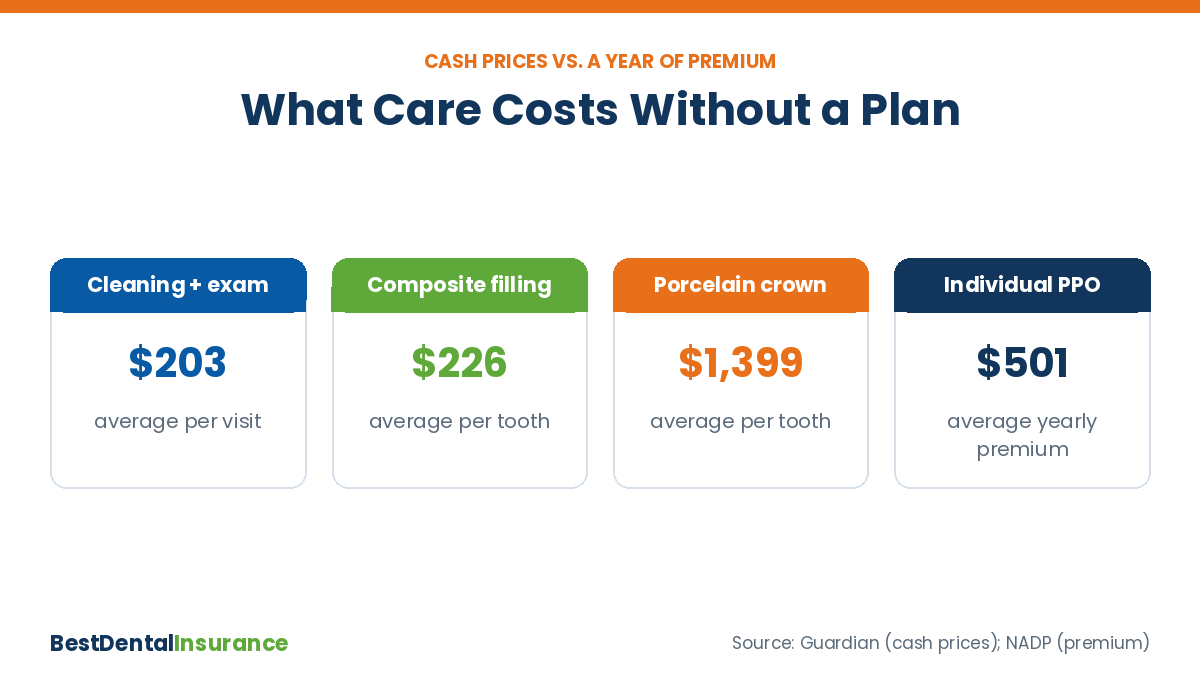
Is dental insurance worth it: average cash prices for a cleaning, filling and crown compared with a yearly PPO premium

Every worth-it question comes down to three figures: your premium, your dentist’s cash price, and the most the plan pays in a year.

The premium. The National Association of Dental Plans (NADP) puts the average individual PPO at $41.76 a month, about $501 a year, and the average individual dental HMO at $15.14 a month.

The cash price. Guardian lists an average of $203 for a cleaning and exam, $226 for a tooth-colored filling, $1,165 for a root canal and $1,399 for a porcelain crown. Prices vary a lot by city and office.

The yearly cap. Most PPOs stop paying at an annual maximum. NADP says about 65% of dental PPOs set it at $1,500 or more, while dental HMOs rarely have one.

Plans also split care into tiers. Many PPOs pay preventive care at or near 100%, basic work such as fillings at about 70% to 80%, and major work such as crowns at about 50%, often after a small deductible. Those percentages, more than the premium, decide how fast coverage earns its keep.

Dental Insurance Quotes

Call a Licensed Agent Now

Compare dental plans for individuals, families and seniors from several insurance companies in one call.

☎ 1-833-667-3396

TTY users 711  |  Mon–Fri: 8am–9pm ET

No obligation to enroll

Break-Even Math: Five Sample Years on One PPO Plan

To see where coverage wins, we ran five possible years for one adult through a sample PPO: $501 yearly premium (the NADP individual average), $50 deductible, 100% preventive, 80% basic, 50% major and a $1,500 annual maximum. Cash prices are Guardian’s national averages. This is an illustration, not a quote; real plans and fees differ.

Sample yearCash totalPremium + your share with planCoverage result
Two cleanings and exams only$406$501 + $0 = $501Costs about $95 more
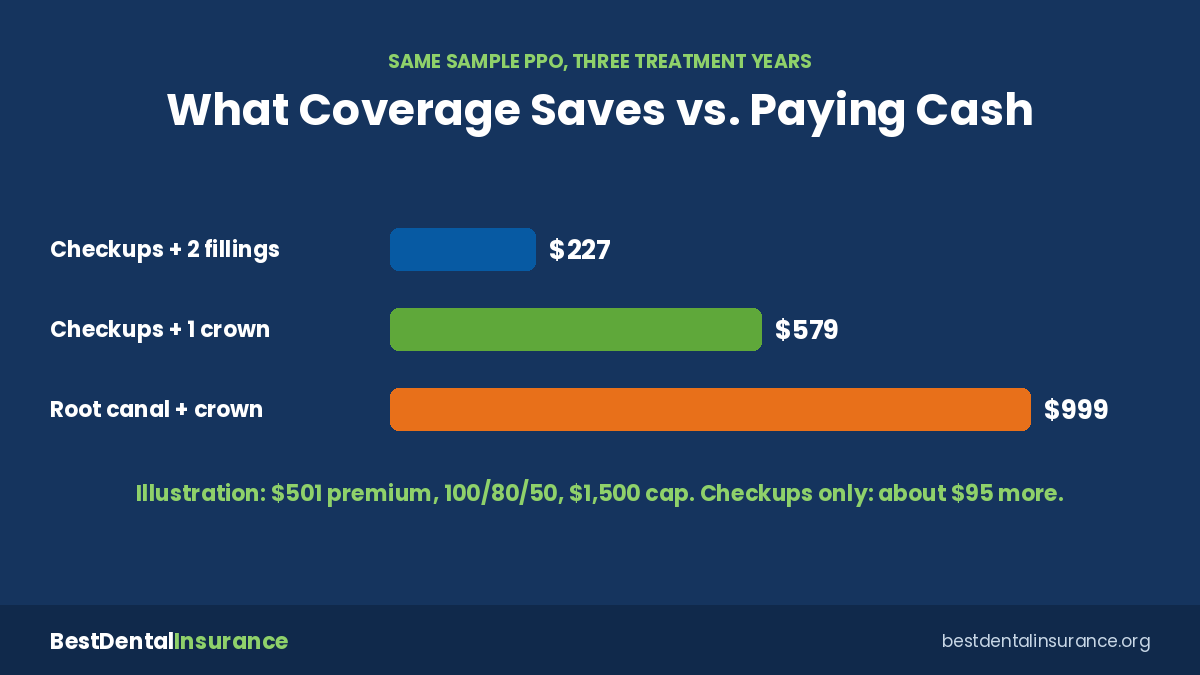
Two checkups + two fillings$858$501 + $130 = $631Saves about $227
Two checkups + one crown (after waiting period)$1,805$501 + $725 = $1,226Saves about $579
Two checkups + root canal + crown$2,970$501 + $1,470 = $1,971Saves about $999 (plan hits $1,500 cap)
Two checkups + crown in month 4 of a 12-month wait$1,805$501 + $1,399 = $1,900Costs about $95 more

Our calculation. Cash prices: Guardian national averages ($203 cleaning and exam, $226 composite filling, $1,165 root canal, $1,399 porcelain crown). Premium: NADP average individual DPPO. Root canal is figured at 50% here; some plans pay it as basic care at a higher rate. Preventive payments count toward the cap in this example; on some plans they do not.

Break-even line: On this sample plan, checkups alone fall about $95 short of the premium. At 80% after a $50 deductible, roughly $170 of basic work, about one filling, closes that gap. Every dollar of care after that is money ahead, until the yearly cap.

One hidden plus is left out: in-network dentists usually charge the plan’s lower contracted fee instead of their cash price, so real PPO savings can be larger.

Who Comes Out Ahead: Kids, Workers, Self-Buyers and Retirees

Families with children. Each child’s two checkups are worth about $406 at average cash prices, and cavity-prevention care like sealants and fluoride is often covered as preventive for kids, with age limits that vary by plan. A family plan whose yearly premium is below the family’s checkup bill is usually a win. See dental insurance for kids.

Workers with an employer plan. If your share were, say, $15 a month ($180 a year), two checkups at cash prices would already beat the premium by about $226. Many employers also let workers pay their share pre-tax through a Section 125 cafeteria plan, which trims the real cost further.

Adults buying their own plan. At full retail price, a healthy adult with no fillings in years may lose about $95 a year, as in the first table row. This group gains most from a low-cost dental HMO or from a PPO only when work is expected.

Retirees on Original Medicare. Original Medicare does not cover most routine dental care, so a retiree pays cash or buys a plan. Our guide for seniors covers Medicare Advantage dental and plans built for older adults.

Where Coverage Stops Paying: Waits, Caps and Exclusions

Is dental insurance worth it: sample yearly savings with a PPO plan for fillings, a crown, and a root canal plus crown
1

Waiting periods. Many individual plans pay for checkups right away but make you wait, often six to twelve months, before covering fillings or crowns. The last table row shows a crown that lands inside the wait: the plan adds nothing, and you are out the premium. Some plans skip waits; see dental plans with no waiting period.

2

The annual maximum. In the root canal and crown year, the sample plan would have owed $1,663 but stopped at $1,500. Large treatment plans can be split across two plan years to use two caps.

3

Exclusions and limits. Cosmetic work like whitening is usually excluded, adult braces are often not covered, and plans limit how often they pay for cleanings, X-rays and crown replacements.

Caps hurt fewer people than the headlines suggest. A 2024 ADA Health Policy Institute analysis reported in ADA News found only 3.4% of dental patients reach a typical annual maximum, and another 3.3% come within $100 of one. For most people, the bigger risk is a waiting period, not the cap.

Fine print that helps you: ADA News explains that once a yearly maximum is used up, a PPO still treats the procedure as a covered benefit even though it pays $0, and the plan may limit an in-network dentist to the PPO fee. That keeps your bill below the cash price even after the cap. Rules depend on state law and the dentist’s contract.

Find & Compare Plans Online

Speak with a licensed insurance agent

1-833-667-3396TTY 711

Mon-Fri: 8am-9pm ET

When a Discount Plan, a Dental HMO or Cash Makes More Sense

Three alternatives fit people the break-even table does not favor.

Dental discount plan. You pay a yearly membership fee and get reduced prices at participating dentists. There is usually no waiting period and no annual maximum, but the plan pays nothing; you pay the discounted fee. Compare the two in dental insurance vs. dental discount plans.

Dental HMO. At about $15 a month on average (NADP), a dental HMO costs far less than a PPO, uses a set copay list and rarely has an annual maximum. The catch is a smaller network and a primary dentist you must use.

Paying cash. A healthy adult who only needs cleanings can ask the office for its self-pay price or an in-house membership, and set aside the would-be premium for surprises.

Running Your Own Numbers Before You Enroll

1

List expected care. Ask your dentist what work is likely in the next 12 months, for each person you would cover.

2

Price it at cash rates. Ask the office for self-pay prices, or use the averages above as a starting point.

3

Apply the plan’s rules. Subtract the deductible, apply each tier’s percentage, and stop at the annual maximum. Check the annual and lifetime maximums.

4

Check the calendar. Move any basic or major work that falls inside a waiting period back to cash.

5

Compare totals. Add the yearly premium to your share. If that total is lower than the cash total, the plan is worth it for you this year.

Do not skip: Confirm your current dentist is in the plan’s network before you enroll. An out-of-network dentist can bill above the plan’s allowed fee, and that gap is yours to pay.

Bottom Line

Dental insurance pays off when the care you expect, run through the plan’s percentages and limits, is worth more than the premium. Families, workers with an employer subsidy and anyone facing fillings or crowns usually come out ahead; a healthy adult buying a PPO at full price for checkups alone may do better with a dental HMO, a discount plan or cash.

See dental plan prices for your ZIP code

Is Dental Insurance Worth It — Frequently Asked Questions

➤ How much dental work do I need for insurance to pay for itself?

On our sample $501-a-year PPO, two checkups plus about $170 of basic work, roughly one filling, reach break-even. Your number depends on your premium, deductible and coverage tiers.

➤ Is it worth buying dental insurance if I only get cleanings?

Often not at full PPO prices, since two average checkups cost about $406 cash against a $501 average premium. It can be worth it with an employer subsidy or a low-cost dental HMO.

➤ Is dental insurance worth it for a family with young children?

Usually yes, because each child’s checkups and common preventive care add up quickly. Compare the family premium with the cash price of everyone’s checkups plus expected fillings.

➤ Should I buy a plan now if I already need a crown?

Check the waiting period first. If major care has a 12-month wait, the plan will not help with a crown you need soon, unless you choose a plan without a wait for major work.

➤ What happens if my dental bill goes over the annual maximum?

You pay the rest yourself. On many PPOs, an in-network dentist may still be limited to the plan’s contracted fee after the cap, depending on state law.

➤ Does my employer plan make dental insurance more worth it?

Usually, because the employer often pays part of the premium and many let you pay your share pre-tax. A lower premium moves the break-even point down.

➤ Is a dental discount plan better than insurance?

It can be for people who need work right away or only want lower cash prices, since there is usually no waiting period. It pays nothing itself, so large bills stay large.

➤ How often do people actually max out their dental plan?

Rarely. An ADA Health Policy Institute analysis found only 3.4% of dental patients reach a typical annual maximum.

Dental Insurance Quotes

Call a Licensed Agent Now

Compare dental plans for individuals, families and seniors from several insurance companies in one call.

☎ 1-833-667-3396

TTY users 711  |  Mon–Fri: 8am–9pm ET

No obligation to enroll

Find & Compare Plans Online

Speak with a licensed insurance agent

1-833-667-3396TTY 711

Mon-Fri: 8am-9pm ET

ZRN Health & Financial Services, LLC, a Texas limited liability company