


Buy Dental Insurance: Where to Shop, When to Enroll and What to Check

Reviewed by Russell Noga, Licensed Insurance Broker — Last updated November 23, 2026

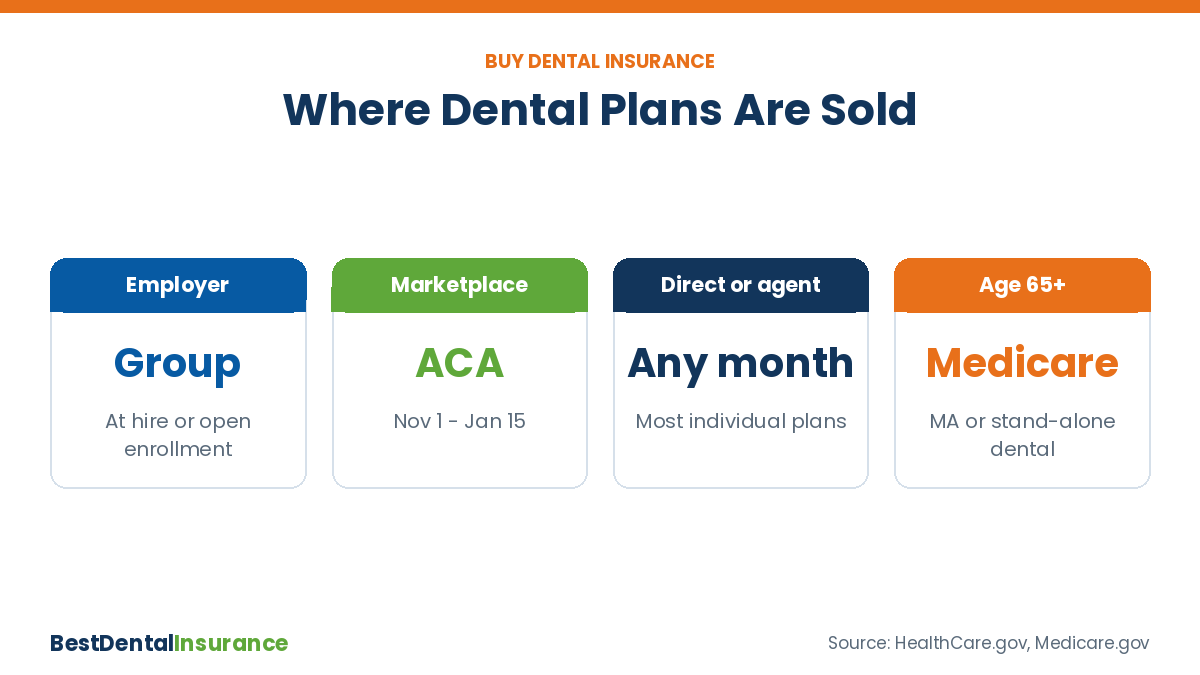
You can buy dental insurance through an employer, on HealthCare.gov or a state exchange alongside a health plan, directly from a dental insurer, through a licensed agent or broker, or, at 65 and older, through a Medicare Advantage plan or a private stand-alone dental policy. Plans sold straight from insurers can usually be bought in any month, while employer, Marketplace and Medicare coverage follow yearly sign-up windows.

2027 by the Numbers

Nov 1 – Jan 15

yearly HealthCare.gov open enrollment window (HealthCare.gov)

Oct 15 – Dec 7

Medicare open enrollment, when Medicare Advantage plans with dental can be picked (Medicare.gov)

98%

of Medicare Advantage enrollees were in plans offering dental benefits in 2026 (KFF)

Dental coverage is sold through more doors than health insurance, and each door has its own calendar and fine print. The right one depends on who you are buying for and how soon treatment is needed.

This guide maps every buying channel, shows when each one is open, and ends with a checklist to run before paying the first premium. For exchange-specific rules, see the full guide to Marketplace dental insurance.
Compare Dental Plans Sold in Your Area

Where Dental Insurance Is Sold

Where to buy dental insurance: employer, Marketplace, direct or agent, and Medicare channels

Working-age buyers mostly use one of four channels below, and some households use two at once. People on Medicare have their own options, covered further down.

Through work. A group plan picked by the employer, often with part of the premium paid by the company and payroll deduction for the rest.

On the ACA exchange. HealthCare.gov or a state-run site sells dental built into health plans or as a separate stand-alone dental plan.

Straight from an insurer. Dental companies sell individual and family policies on their own websites, usually with an online application.

Through a licensed agent or broker. One professional can show plans from several insurers side by side and help with the paperwork.

Two smaller channels round out the list. Some membership organizations and warehouse clubs arrange dental plans for members, such as the options covered in our review of Costco dental insurance. Low-income adults and children can also apply for Medicaid or CHIP at any time of year, though adult Medicaid dental benefits vary widely by state.

Dental Insurance Quotes

Call a Licensed Agent Now

Compare dental plans for individuals, families and seniors from several insurance companies in one call.

☎ 1-833-667-3396

TTY users 711  |  Mon–Fri: 8am–9pm ET

No obligation to enroll

Every Buying Channel Compared

Who each channel suits, when it accepts new enrollees and the catch that most often surprises buyers:

ChannelBest fitWhen you can buyMain catch
Employer group planWorkers whose job offers dentalAt hire, open enrollment or after a qualifying life eventCoverage usually ends with the job unless COBRA is elected
ACA MarketplaceFamilies buying health coverage on the exchangeNov 1 – Jan 15 on HealthCare.gov, or a special enrollment periodHealthCare.gov will not sell dental unless a health plan is bought at the same time
Direct from an insurerSelf-employed people, early retirees, anyone off-cycleUsually any monthWaiting periods for basic and major care are common
Licensed agent or brokerShoppers who want several insurers compared at onceSame as the plans being soldAgents may not represent every insurer in your area
Membership groupMembers of clubs or associations that sponsor plansSet by the group and insurerMembership may be required to keep the plan
Medicare AdvantagePeople 65+ or on Medicare who want dental inside their Medicare planOct 15 – Dec 7, or Jan 1 – Mar 31 to switch plansDental benefits differ sharply from plan to plan
Private stand-alone policy at 65+Original Medicare users, with or without MedigapUsually any monthSeparate premium and its own yearly maximum

Sources: HealthCare.gov, Medicare.gov, KFF and insurer enrollment pages, reviewed November 2026. State-run exchanges may set different dates.

Timing note: Off-cycle buyers are not locked out. A plan bought directly from a dental insurer can generally start within weeks, even when the Marketplace and employer windows are closed. See when open enrollment for dental insurance happens for every deadline.

Picking a Channel for Your Household

A few rules that rarely show up in shopping guides change the math for different households.

Parents of young children. Dental care for kids 18 and under is an essential health benefit, so every exchange must make it available. Buying it is optional in most states.

Parents of grown children. The ACA rule letting children stay on a parent’s plan to age 26 does not apply to fully insured stand-alone dental plans, which are excepted benefits. Each plan sets its own dependent age limit.

Workers with an HSA. IRS Publication 969 does not list dental insurance premiums as a qualified expense, so they are normally paid with after-tax money. HSA funds can still pay the dentist’s bills.

People between jobs. COBRA can continue a work dental plan for a limited time, and HSA money can pay COBRA premiums.

Adults on the exchange generally pay the full premium for a separate dental plan, since tax credits mainly reach the children’s portion, so comparing exchange plans with direct policies makes sense.

Buying Dental Insurance at 65 and Older

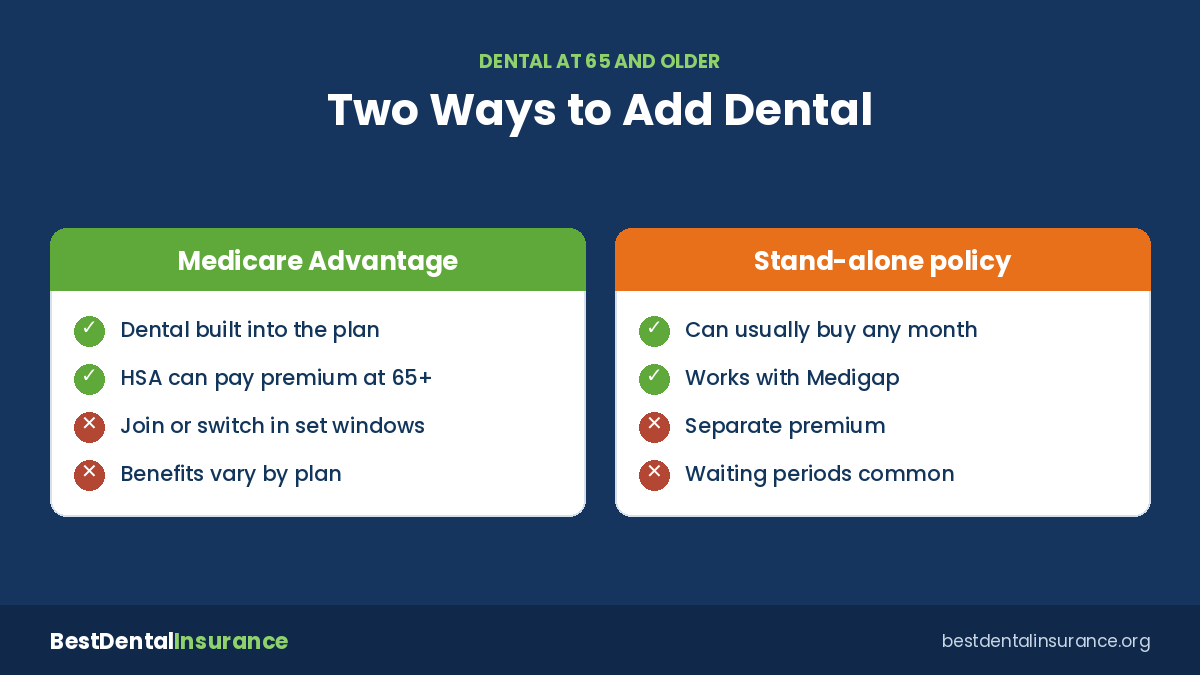
Buy dental insurance at 65: Medicare Advantage dental compared with a stand-alone dental policy

Original Medicare does not cover most routine dental care, such as cleanings, fillings and dentures. There are two main ways to add it.

Medicare Advantage with dental. Dental is bundled into a private Medicare plan. Some plans cover only cleanings and exams, while others add fillings, root canals or dentures, sometimes with prior authorization.

Private stand-alone dental. A separate policy that works alongside Original Medicare and a Medigap plan, which does not cover routine dental. It can usually be bought any month.

Worth knowing: At 65 and older, HSA funds may pay Medicare Advantage premiums, but not Medigap premiums, under IRS Publication 969. A Medicare Advantage plan with dental can therefore be paid from an HSA in a way a stand-alone dental policy generally cannot.

Our guide to Medicare dental plans explains how to compare dental benefits across Medicare Advantage plans and private policies.

Find & Compare Plans Online

Speak with a licensed insurance agent

1-833-667-3396TTY 711

Mon-Fri: 8am-9pm ET

Fine Print to Read Before You Pay

Two plans with similar premiums can pay very differently. Open the summary of benefits and the exclusions list and look for these terms.

Network. Confirm your dentist is in network. Out-of-network visits often cost more, and HMO-style plans may pay nothing outside the network.

Waiting periods and yearly maximum. Many plans make you wait months for fillings or crowns and stop paying once a yearly cap, often $1,000 to $2,000, is reached.

Coinsurance tiers. A common setup pays preventive care at or near 100%, basic care at 70-80% and major care at about 50%, but this varies by plan.

Missing tooth clause. Some plans refuse to pay to replace a tooth lost before coverage began, leaving the full cost of a bridge, implant or denture to you.

Also note frequency limits on exams and X-rays, and whether orthodontics covers adults or only children.

A Seven-Step Checklist for Buying Your Plan

1

List who needs coverage. Note ages, any Medicare enrollment, and whether a child or young adult will be on the plan.

2

Write down known treatment. A pending crown, missing tooth or braces will steer you toward plans without long waits or a missing tooth clause.

3

Check what you already have. Look at your employer, spouse’s employer and health plan, since some health plans already include dental.

4

See which windows are open. Employer, Marketplace and Medicare plans need an open window; direct and agent-sold plans usually do not.

5

Get quotes from more than one channel. Compare at least one exchange or employer option with plans sold directly or through an agent.

6

Read the summary and exclusions. Match the network, waiting periods, yearly maximum and coinsurance tiers against your list.

7

Confirm the start date and billing. Ask when coverage begins, how premiums are paid and what happens if a payment is missed.

For a deeper side-by-side method once you have quotes in hand, see how to compare dental plans.

Bottom Line

Where you buy dental insurance decides when you can enroll, who helps pay and which rules protect you. Check the windows that are open, gather quotes from at least two channels, and read the waiting periods, yearly maximum and missing tooth language before paying.

Check dental plan prices for your ZIP code

Buy Dental Insurance — Frequently Asked Questions

➤ Where is the cheapest place to buy dental insurance?

For workers, a job-based plan is often cheapest because the employer may pay part of the premium. Without one, prices from the exchange, insurers and agents are worth comparing, since adults usually get no tax credit for stand-alone dental.

➤ Does buying through an agent cost more than buying direct?

Agents are usually paid by the insurer, so using one typically adds no separate fee.

➤ Can I pay dental insurance premiums with my HSA?

Generally no. IRS rules limit HSA-paid premiums to COBRA, coverage while receiving unemployment, long-term care insurance and Medicare coverage at 65 or older. HSA money can still pay dental treatment bills.

➤ Can my 24-year-old stay on my dental plan?

It depends on the plan. The ACA age-26 rule does not apply to fully insured stand-alone dental plans, so each plan sets its own cutoff, which may be younger than 26.

➤ Can I buy dental insurance online without speaking to anyone?

Yes. Many dental insurers let you get a quote, apply and pay online, and HealthCare.gov handles exchange enrollment online during open enrollment.

➤ Should I buy dental insurance if I already need a crown?

Possibly, but check waiting periods first. Many plans delay major care for months, so a plan with no wait for major services or a discount plan may fit better.

➤ I have Original Medicare and a Medigap plan. How do I add dental?

Medigap does not cover routine dental, so the usual route is a private stand-alone dental policy, which can generally be bought any month. Switching to a Medicare Advantage plan with dental is another option during Medicare enrollment periods.

➤ Can I buy dental insurance for my child only?

Yes. Many insurers sell child-only dental policies, exchanges must offer pediatric dental, and children in lower-income families may qualify for Medicaid or CHIP dental coverage.

Dental Insurance Quotes

Call a Licensed Agent Now

Compare dental plans for individuals, families and seniors from several insurance companies in one call.

☎ 1-833-667-3396

TTY users 711  |  Mon–Fri: 8am–9pm ET

No obligation to enroll

Find & Compare Plans Online

Speak with a licensed insurance agent

1-833-667-3396TTY 711

Mon-Fri: 8am-9pm ET

ZRN Health & Financial Services, LLC, a Texas limited liability company