


Marketplace Dental Insurance: How ACA Dental Plans Work for 2027

Reviewed by Russell Noga, Licensed Insurance Broker — Last updated November 2, 2026

Marketplace dental insurance is dental coverage you buy through HealthCare.gov or your state’s ACA exchange, either built into a health plan or as a separate stand-alone dental plan. For 2027 coverage, open enrollment on HealthCare.gov runs November 1, 2026 to January 15, 2027, and in HealthCare.gov states you generally must pick a health plan to add dental.

2027 by the Numbers

Nov 1 – Jan 15

HealthCare.gov open enrollment for 2027 coverage (HealthCare.gov)

$450 / $900

stand-alone pediatric dental out-of-pocket cap, one child / two+ (CMS, 2026)

60 days

usual special enrollment window after a life event (HealthCare.gov)

The ACA exchange is best known for health insurance, but it also sells dental plans. The rules for a 7-year-old and a 37-year-old are very different, and so are the rules in Texas versus New York.

Below: what federal rules say, how the two plan setups differ, who can use a tax credit for dental, and which states sell dental by itself. If price is your main question, see the average cost for dental insurance.
Compare Dental Plans in Your Area

What Counts as Marketplace Dental Coverage

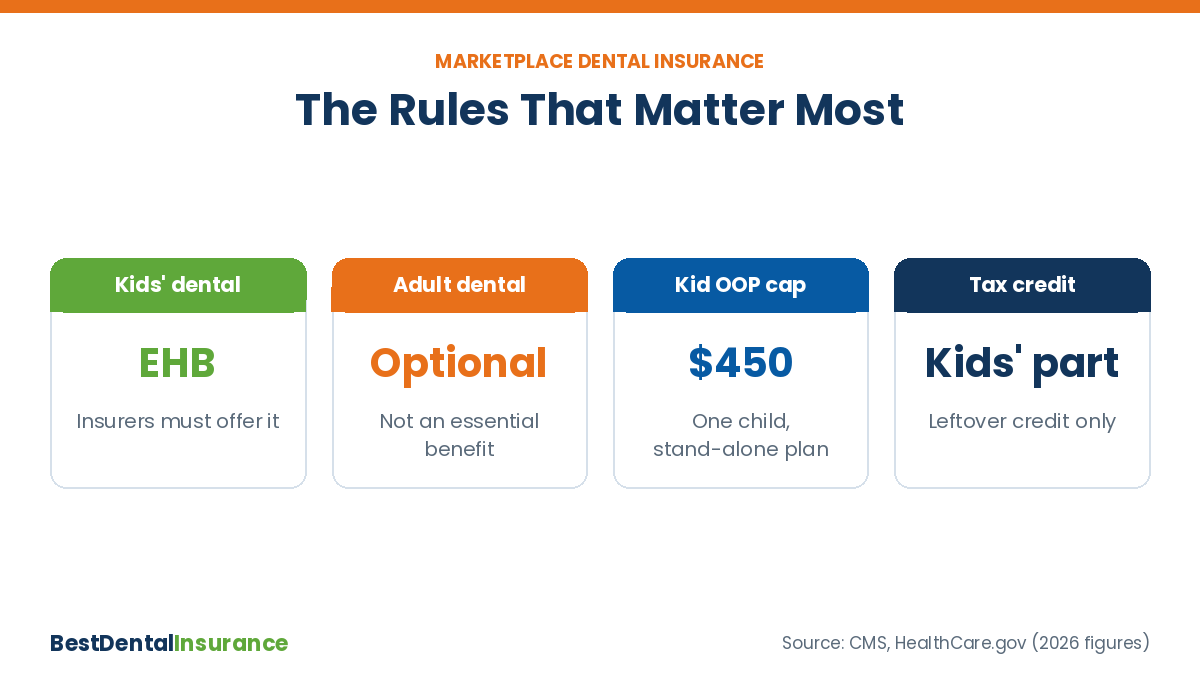
Marketplace dental insurance key rules for kids and adults on HealthCare.gov

The Health Insurance Marketplace is the ACA shopping site. Most states use HealthCare.gov; others run their own exchange. Dental appears in two forms.

Embedded dental. Dental benefits are part of the medical plan itself. You pay one premium and one deductible system covers both.

Stand-alone dental plan (SADP). A separate dental policy from a dental company, picked on the same application as your health plan and billed on its own.

Who can apply. Individuals and families not on Medicare, including self-employed people and anyone without a job-based plan.

The key split: the law treats children’s dental care as required health coverage, but not adult dental care. That shapes prices, limits and subsidies.

Dental Insurance Quotes

Call a Licensed Agent Now

Compare dental plans for individuals, families and seniors from several insurance companies in one call.

☎ 1-833-667-3396

TTY users 711  |  Mon–Fri: 8am–9pm ET

No obligation to enroll

Children vs. Adults: Side-by-Side Federal Rules

No single government page shows the child and adult rules next to each other, so we pulled them from CMS and HealthCare.gov guidance into one table.

RulePediatric dental (kids)Adult dental
Essential health benefit?YesNo
Must insurers offer it?Yes, embedded or through a stand-alone plan in the areaNo, it is optional for insurers
Yearly or lifetime dollar caps on benefitsNot allowedAllowed; low yearly maximums are common
Out-of-pocket limit in a stand-alone plan$450 one child, $900 two or more (2026)No federal limit
Premium tax creditLeftover credit can go toward the pediatric part of a stand-alone premiumGenerally no; adults usually pay the full dental premium
Cost-sharing reductionsNot available on stand-alone plansNot available on stand-alone plans

Sources: CMS stand-alone dental plan job aid; HealthCare.gov; CMS draft 2027 Letter to Issuers, which keeps the $450 / $900 figures for 2027 (final guidance may differ).

Rule of thumb: Adult dental on the exchange is ordinary private dental insurance sold on a government website, with the usual yearly maximums, coinsurance tiers and waiting periods.

Embedded Health Plan Dental or a Separate Dental Plan?

When a medical plan includes pediatric dental, the family’s costs fall under that plan’s single out-of-pocket maximum. But dental bills may count toward the medical deductible first, so a child’s filling could be paid by the family until a large deductible is met.

Embedded works best when the medical deductible is low or your state requires preventive and basic dental to be covered before it.

A separate plan works best when you have a high-deductible medical plan and want a small, fixed dental deductible and its own low out-of-pocket cap for kids.

State twist. California, Connecticut and Maryland require every on-exchange medical plan to embed pediatric dental, so families there do not choose.

States can also set tighter numbers than CMS. Connecticut’s 2027 standard dental design caps pediatric out-of-pocket costs at $350 for one child and $700 for two or more, below the federal figure. For more on covering children outside the exchange, see our guide to dental insurance for kids.

Open Enrollment Dates for 2027 Dental Coverage

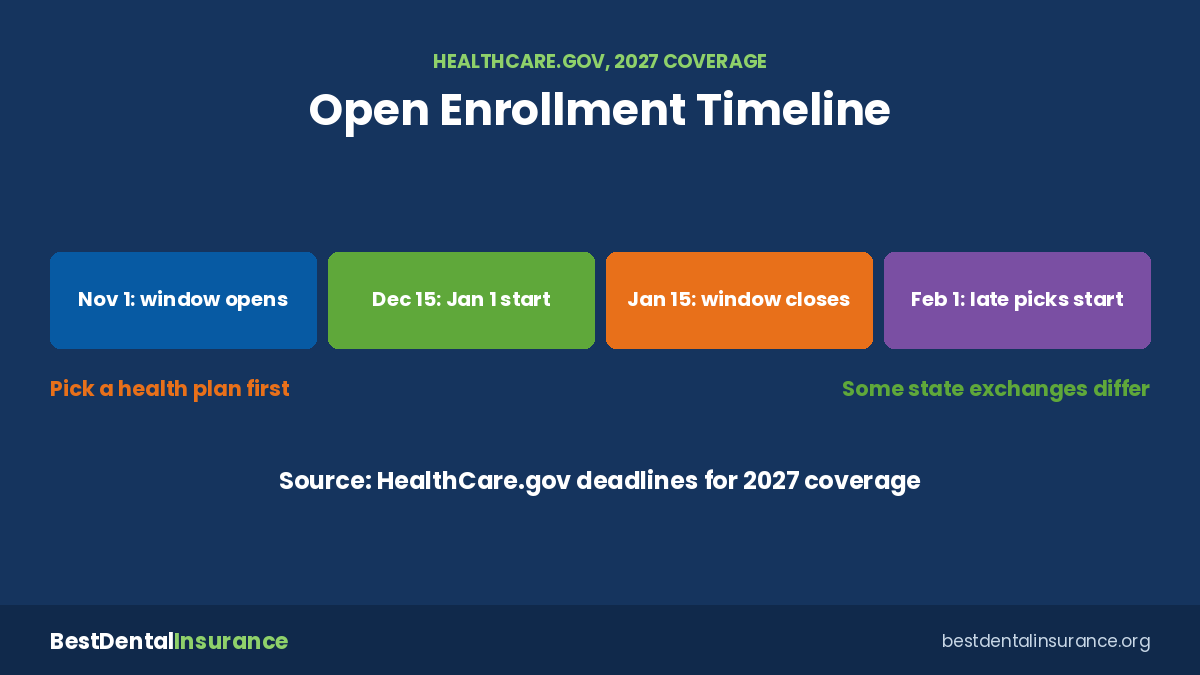
Marketplace dental insurance open enrollment timeline for 2027 coverage on HealthCare.gov

On HealthCare.gov, the window for 2027 plans runs November 1, 2026 to January 15, 2027. Pick a plan by December 15 and coverage starts January 1; pick one later and it starts February 1. A federal rule to end every state’s window earlier was set aside by a court in June 2026 and is on appeal, so recheck before the deadline.

ExchangeLast day for 2027 coverage
HealthCare.gov statesJanuary 15, 2027
IdahoDecember 15, 2026
Rhode IslandDecember 31, 2026
MassachusettsJanuary 23, 2027
VirginiaJanuary 29, 2027
California, New Jersey, New York, D.C.January 31, 2027

State-run exchanges set their own deadlines and can extend them. Confirm on your exchange’s site.

Outside that window you need a qualifying life event, such as losing coverage, moving, marriage or a new baby, and you usually have 60 days to enroll. On HealthCare.gov, you still cannot add a stand-alone dental plan without also enrolling in a health plan.

Find & Compare Plans Online

Speak with a licensed insurance agent

1-833-667-3396TTY 711

Mon-Fri: 8am-9pm ET

Which States Let You Buy Dental Without a Health Plan

On HealthCare.gov you need a health plan to buy exchange dental, but several state-run exchanges sell dental by itself.

RuleStates or exchanges
Health plan required to add dentalHealthCare.gov states, plus California and Washington
Dental-only during open or special enrollmentColorado, Connecticut, D.C., Georgia, Idaho, Illinois, Kentucky, Maine, Maryland, Minnesota, Nevada, New Jersey, New York, Pennsylvania, Rhode Island, Vermont, Virginia
Dental-only year-roundMassachusetts, New Mexico
Must buy pediatric dental if anyone is 18 or youngerWashington
Waiting periods banned on adult stand-alone plans (except orthodontia)New York

Compiled from state exchange rules summarized by healthinsurance.org, reviewed November 2026. Rules can change each plan year.

Have Medicare? The exchange is not built for people on Medicare, and you would shop elsewhere. Some Medicare Advantage plans include dental benefits that vary by plan, and private stand-alone dental plans fill the gap for Original Medicare. Our Medicare dental plans guide covers those options.

How to Shop for Dental on the Exchange, and When to Look Elsewhere

1

Choose the health plan first. In HealthCare.gov states the dental options appear after you pick a medical plan.

2

Check whether dental is already embedded. Look at the plan details for pediatric dental before paying for a second dental premium.

3

Compare the kid cap and the adult maximum. For children, look at the out-of-pocket limit; for adults, the yearly benefit maximum and coinsurance for fillings and crowns.

4

Watch the payment rules. Dropping a stand-alone plan or missing payments can lock you out of exchange dental until the next open enrollment.

Outside the exchange: Adults who get no tax credit for dental can buy similar plans directly from dental carriers in any month. Compare waiting periods, since many direct plans delay basic and major care.

A dental discount plan is another route. It is not insurance, but it gives reduced fees at member dentists; see dental insurance vs. dental discount plans. If timing matters, read about dental insurance waiting periods.

Bottom Line

Marketplace dental insurance gives children strong federal protections, including a low out-of-pocket cap, while adult exchange dental works like any private dental plan, usually without a tax credit. In HealthCare.gov states you add dental to a health plan between November 1 and January 15, but several state exchanges sell dental by itself.

Related: when is open enrollment for dental insurance outside the exchange Every 2027 sign-up window for individual, job-based, Medicare and FEDVIP dental plans in one table.

Related: Ambetter dental insurance add-on for adults How Ambetter’s + Vision + Adult Dental plans work, where they are sold and what they exclude.

See dental plans & rates in your ZIP code

Marketplace Dental Insurance — Frequently Asked Questions

➤ Can I get dental insurance on HealthCare.gov without buying a health plan?

Generally no. In HealthCare.gov states you must also enroll in a health plan, even during a special enrollment period. Some state exchanges, such as New York, Colorado and Maryland, sell dental by itself.

➤ Do ACA subsidies pay for dental insurance?

Only in a narrow way. If your premium tax credit is larger than your health plan premium, the leftover amount can be applied to the pediatric part of a stand-alone dental premium. Adult dental premiums are usually paid in full by the enrollee.

➤ Is dental insurance required for my kids on the exchange?

Insurers must offer pediatric dental, but most families are not required to buy it. Washington requires it for households with anyone 18 or younger, and California, Connecticut and Maryland embed it in every exchange medical plan.

➤ What is the out-of-pocket maximum for a stand-alone pediatric dental plan in 2027?

The federal cap is $450 for one child and $900 for two or more in 2026, and CMS’s draft 2027 guidance keeps those figures. Some states set lower caps, so check your plan’s summary.

➤ Do exchange dental plans for adults have waiting periods?

They can. Adult dental is not an essential health benefit, so insurers may use waiting periods unless a state bans them. New York, for example, bars them on adult stand-alone plans except for orthodontia.

➤ Can I cancel a Marketplace dental plan and keep my health plan?

Yes. You can end a stand-alone dental plan through the dental company or the Marketplace and keep your medical coverage, but you may not be able to re-enroll in exchange dental until the next open enrollment.

➤ Can I use the Marketplace for dental if I’m on Medicare?

The exchange is designed for people without Medicare. Look instead at Medicare Advantage plans with dental benefits or a private stand-alone dental plan sold outside the exchange.

➤ What happens if I miss January 15 on HealthCare.gov?

You will need a qualifying life event, such as a move or loss of coverage, to enroll in 2027 exchange coverage. You can still buy dental directly from a carrier any time of year.

Dental Insurance Quotes

Call a Licensed Agent Now

Compare dental plans for individuals, families and seniors from several insurance companies in one call.

☎ 1-833-667-3396

TTY users 711  |  Mon–Fri: 8am–9pm ET

No obligation to enroll

Find & Compare Plans Online

Speak with a licensed insurance agent

1-833-667-3396TTY 711

Mon-Fri: 8am-9pm ET

ZRN Health & Financial Services, LLC, a Texas limited liability company