




Does Dental Insurance Cover Night Guards? Plan Rules, Codes and What You Pay

Reviewed by Russell Noga, Licensed Insurance Broker — Last updated November 8, 2026

Yes, many dental insurance plans cover a custom night guard when your dentist documents tooth wear or fractures from grinding or clenching, usually once every few years. Coverage is not universal: some individual plans exclude bruxism appliances entirely, and others pay 50% as a major service or a flat amount such as $200.

2027 by the Numbers

$405

median in-network rate for a hard full-arch guard, D9944 (PayorMap, March 2026)

1 per 36 mo.

guard frequency limit in Centene’s Envolve dental clinical policy

$200

maximum guard benefit, once per 5 years, on one 2026 Delta Dental PPO plan in Oregon

A night guard is a plastic tray worn over your teeth while you sleep. It takes the force of grinding (bruxism) or clenching so your enamel, crowns and fillings do not. A dentist-made guard can cost several hundred dollars, so coverage matters to single adults, parents of teens who grind, and retirees alike.

The answer lives in two places: the billing code your dentist uses and the exclusions page of your policy. Plans that cover guards often place them with major dental services, so that tier’s cost sharing and waiting periods apply.
Compare Dental Plans That Include Night Guards

The Codes Behind a Night Guard Claim

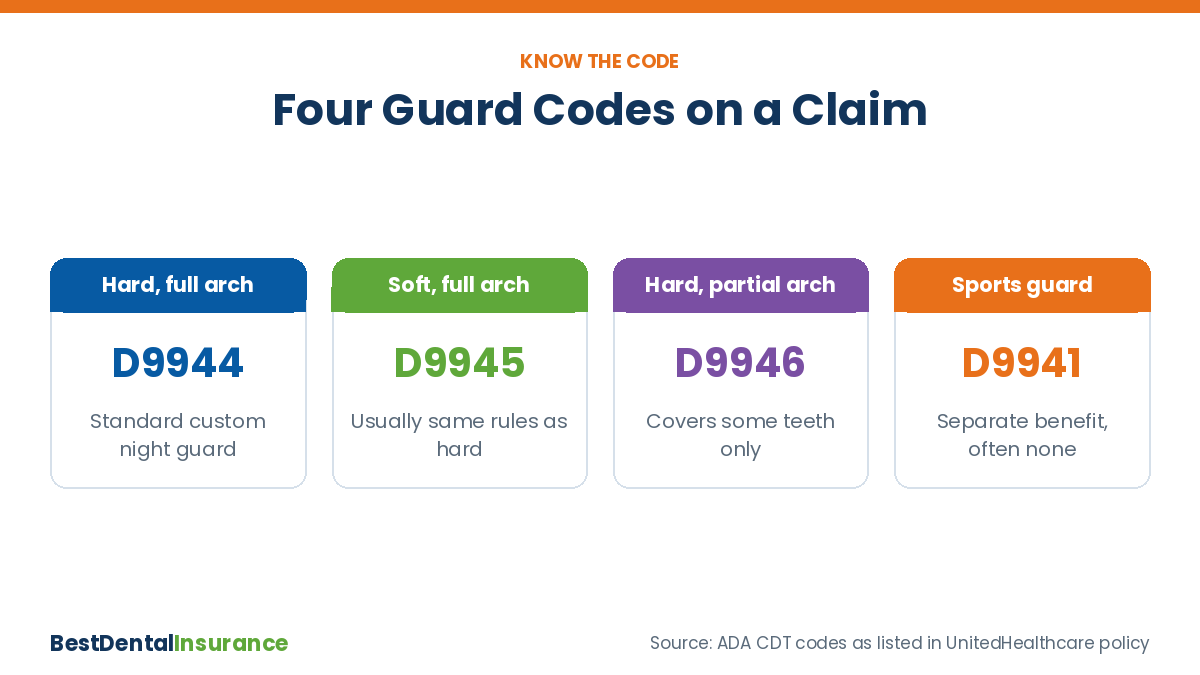
Does dental insurance cover night guards: the four CDT codes for night guards and sports mouthguards

Dental offices bill guards with codes from the American Dental Association’s CDT code set. Insurers call a night guard an occlusal guard.

CDT codeWhat it isWhere it fits on most plans
D9944Occlusal guard, hard appliance, full archThe standard custom night guard; covered on some plans, with a frequency limit
D9945Occlusal guard, soft appliance, full archSame rules as D9944 on most policies
D9946Occlusal guard, hard appliance, partial archCovers only some teeth; claim lists the arch and quadrant
D9941Fabrication of an athletic mouthguardA separate sports benefit, if offered at all
D7880Occlusal orthotic device for TMJ disordersReviewed as TMJ treatment, often under medical rules

Descriptors per UnitedHealthcare’s 2026 dental clinical policy. A guard with any hard layer is billed as hard (Arizona Health Choice policy D0017).

Code check: Ask which code the office plans to bill. A D9944 guard is judged on grinding damage; a D7880 device is judged as jaw joint treatment, under different rules.

Dental Insurance Quotes

Call a Licensed Agent Now

Compare dental plans for individuals, families and seniors from several insurance companies in one call.

☎ 1-833-667-3396

TTY users 711  |  Mon–Fri: 8am–9pm ET

No obligation to enroll

Six Plan Documents, Six Different Answers

We read plan summaries, exclusion lists and clinical policies to compare night guard rules in writing. Each row is one document, not every plan that carrier sells.

Plan documentNight guard treatmentFrequency or limitFine print
Delta Dental PPO 50, Multnomah County, Oregon (2027 group plan)Class 3 major service at 50% after the deductible; for grinding or TMJOne guard every 3 calendar yearsLost or broken guards not replaced until 3 years pass
Delta Dental PPO Plan 2 Mid Plan, Oregon (2026 group plan)Paid at 100%Once in 5 years, up to $200Store-bought night guards excluded
Delta Dental of South Dakota individual and family plansNot coveredNot applicableAppliances for grinding or clenching and TMJ appliances are excluded
NCD by MetLife individual plans (Core, Elite, Bright)Not coveredNot applicableOcclusal guards and night guards listed as exclusions
Cigna Dental Care DHMO (group brochure)Patient copay set by the plan’s charge scheduleReplacement limited to one per 24 months where notedCopay amount is on the Patient Charge Schedule
UnitedHealthcare dental clinical policy (2026)Paid only if the member’s plan includes guardsSet by the planNot for TMJ disorders, headaches, sports or braces

Our comparison of public plan documents from Delta Dental Plan of Oregon, Moda, Delta Dental of South Dakota, NCD by MetLife, Cigna and UnitedHealthcare. Terms vary by state and employer and change yearly.

The pattern: richer employer plans tend to include guards, while some low-cost individual plans exclude them. Buying your own policy? Search the exclusions for bruxism, grinding or occlusal, and note any waiting period for major care.

Proving Bruxism and Getting Pre-Approval

Plans that cover guards want proof of damage, not just a sore jaw. Centene’s Envolve policy approves a guard for heavy wear or repeated fractures, or when porcelain crowns oppose natural teeth. Arizona’s Health Choice policy asks for moderate to severe wear.

1

Get the exam and records first. Clinical notes, X-rays and intraoral photos showing worn, chipped or cracked teeth are the evidence most policies list.

2

Have the dentist write a narrative. A short note on the grinding, the teeth affected and why a guard is needed. Billing guides say a panoramic X-ray helps.

3

Request a pre-treatment estimate. The office sends the code and fee to your insurer, which replies with what it expects to pay. It is not a payment guarantee.

4

Check the last guard date. If a guard was paid within the plan’s 3- or 5-year window, a new one is usually denied, even if the old one broke.

Sports Guards, TMJ Splints and Medical Insurance

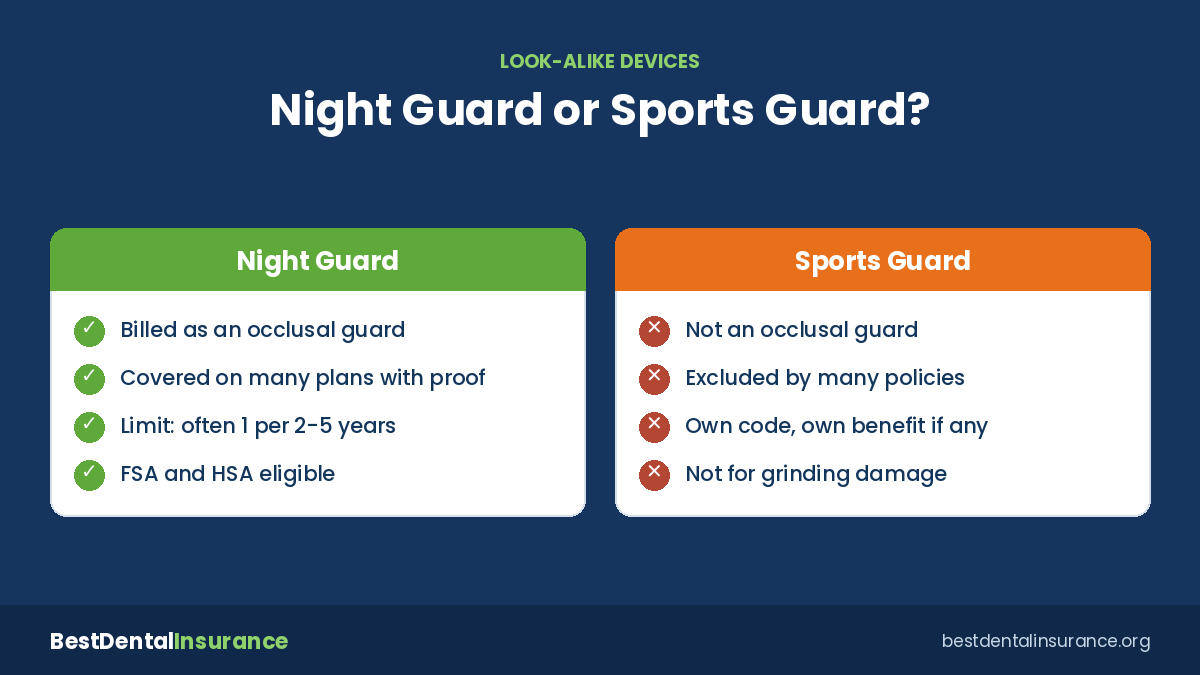
Night guard vs sports mouthguard and whether dental insurance covers each

Sports guards protect teeth from a blow during play. Night guards protect teeth from your own grinding. TMJ splints aim to treat the jaw joint itself, and each is covered differently.

Sports mouthguards. UnitedHealthcare and Arizona Health Choice policies say an occlusal guard is not for athletic use. A few plans, like the Multnomah County Delta Dental plan, list athletic guards as a separate benefit.

TMJ appliances. UnitedHealthcare sends guards for jaw disorder symptoms to a separate medical policy, so a health plan may review them when a TMJ disorder is diagnosed. Ask whether it needs a diagnosis, referral or prior authorization first.

Jaw joint care has its own rules and costs, covered in our guide to the best dental insurance for TMJ.

Find & Compare Plans Online

Speak with a licensed insurance agent

1-833-667-3396TTY 711

Mon-Fri: 8am-9pm ET

Night Guard Prices With and Without Coverage

Prices vary by material, lab and region. Ranges below come from GoodRx and PayorMap’s analysis of insurer price files.

OptionReported priceSource
Custom guard from a dentist, paying yourself$300 to $1,000; most dual-laminated guards $300 to $500GoodRx
In-network negotiated rate, D9944Median $405; range $90 to $1,337 across 47 statesPayorMap, March 2026
Lab-made guard from an online impression kit$50 to $200GoodRx
Stock store-bought guardAbout $20 to $30GoodRx

Negotiated rates are fees insurers agreed to in network, not quotes or proof a plan pays.

Run the numbers: Take a $405 in-network fee. A plan paying 50% after a $50 deductible pays about $177.50, leaving you about $227.50. A plan paying 100% up to $200 leaves you about $205.

Tax-free accounts can cover your share. The HSA Store lists night mouth guards as eligible for FSA, HSA and HRA reimbursement when used for a medical purpose such as grinding. Keep an itemized receipt.

Cheaper Routes and Coverage for Seniors

Store-bought guards. Stock and boil-and-bite guards cost the least but fit loosely. Ask your dentist whether one suits your bite.

Dental discount plans. A membership lowers the fee at participating dentists, with no claim to deny. See dental insurance vs. dental discount plans.

Employer open enrollment. If your job offers more than one dental tier, the higher tier is where guards most often appear in the documents we read.

Medicare and seniors. Original Medicare does not cover most routine dental care. Medicare Advantage dental benefits vary; one 2025 Humana Medicare dental summary did not list guards and says unlisted services are not covered. See the limits of dental coverage under Medicare.

Bottom Line

Many dental plans cover night guards, but only with proof of grinding damage and usually once every 3 to 5 years. Some individual plans exclude them, so read the exclusions, get a pre-treatment estimate, and use FSA or HSA dollars for your share.

Check night guard coverage on plans in your ZIP code

Night Guards and Dental Insurance — Frequently Asked Questions

➤ Is a night guard considered preventive care?

Usually not. Plans that cover guards tend to place them with basic or major services, so a deductible and coinsurance often apply.

➤ How often will my plan replace a night guard?

Documents we checked limit guards to one every 2, 3 or 5 years. If yours breaks early, you may pay for the replacement yourself.

➤ Why was my night guard claim denied?

Common reasons are no proof of tooth wear, a guard already paid within the frequency window, a grinding-appliance exclusion or an unfinished waiting period. If records were missing, ask the office to resubmit with X-rays and a narrative.

➤ Does insurance pay for a soft night guard?

Soft full-arch guards use code D9945, and most plans that cover guards treat them like hard guards. You may still be limited to one guard of any type per window.

➤ Can my teen’s sports mouthguard be billed as a night guard?

No. A sports mouthguard has its own code, D9941, and clinical policies say an occlusal guard is not for athletic use.

➤ Will insurance cover a night guard I order online?

Rarely. Plans pay dentist-made guards billed under a guard code, and some exclude store-bought guards by name. FSA or HSA funds may work instead.

➤ Do I need a pre-treatment estimate for a night guard?

It is not always required, but it shows what your plan expects to pay before the guard is made.

➤ Does a Medicare Advantage plan cover night guards?

Some may, but it varies by plan. Check the dental section of the Evidence of Coverage, since unlisted services are generally not covered.

Dental Insurance Quotes

Call a Licensed Agent Now

Compare dental plans for individuals, families and seniors from several insurance companies in one call.

☎ 1-833-667-3396

TTY users 711  |  Mon–Fri: 8am–9pm ET

No obligation to enroll

Find & Compare Plans Online

Speak with a licensed insurance agent

1-833-667-3396TTY 711

Mon-Fri: 8am-9pm ET

ZRN Health & Financial Services, LLC, a Texas limited liability company