

Free Dental Care for Adults Without Insurance: Where to Go and What Each Option Really Covers

Reviewed by Russell Noga, Licensed Insurance Broker — Last updated November 17, 2026

Free dental care for adults without insurance is available at federally funded community health centers, which must offer income-based sliding fees and cannot turn anyone away for inability to pay, and at dental school clinics, volunteer clinic events such as Mission of Mercy and Remote Area Medical, and Dental Lifeline Network’s Donated Dental Services. Medicaid also covers adult dental in most states, but every free option comes with a waitlist, a line or strict eligibility.

2027 by the Numbers

$15,960

2026 federal poverty guideline for one adult; at or below it, HRSA health centers must give a full discount or charge only a nominal fee (HHS, HRSA)

6.75 million

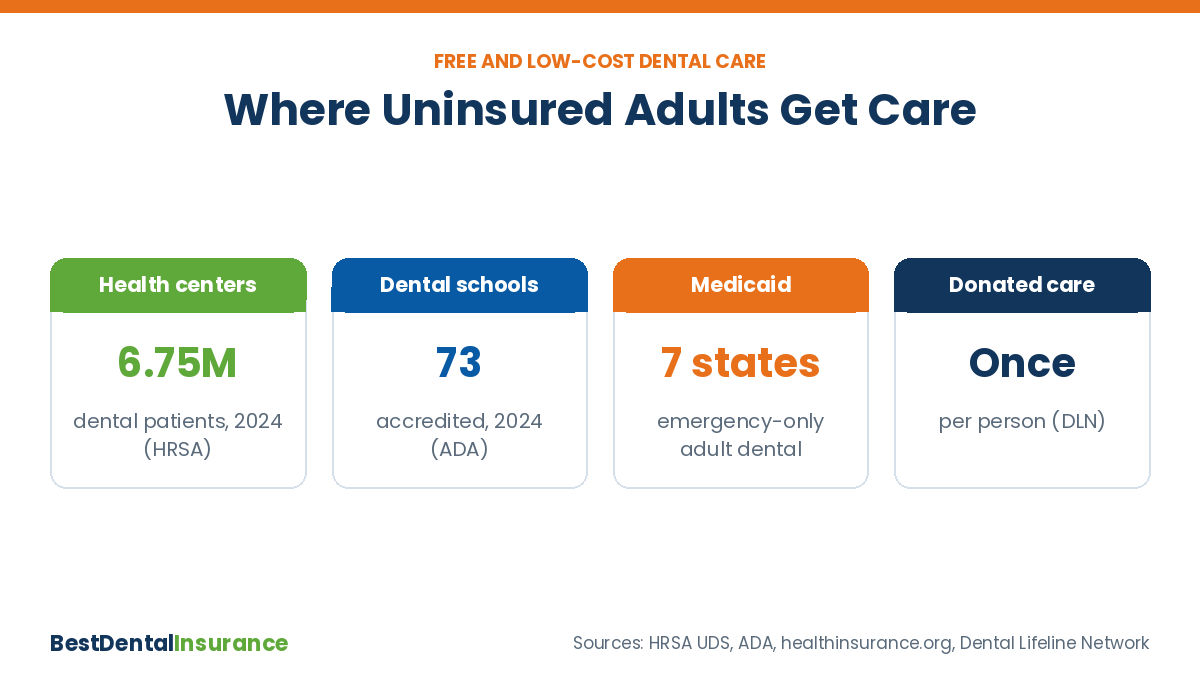
patients who received dental care at HRSA-funded health centers in 2024 (HRSA Uniform Data System)

7 states

that limit adult Medicaid dental to emergencies only, with Alabama covering none for most adults (healthinsurance.org, 2025)

Being uninsured does not mean going without a dentist. Free and reduced-fee care exists in every state, spread across clinics, schools, charities and public programs with their own rules.

Below, each option is sorted by what it treats, who gets in and how long it takes, followed by ways to avoid being uninsured next time. For keeping premiums low, see our tips for finding affordable dental insurance.
Compare Low-Cost Dental Plans in Your Area

Where Uninsured Adults Can Get Free or Low-Cost Dental Care

Free dental care for adults without insurance: health center dental patients, dental schools, Medicaid emergency-only states and donated care

This side-by-side view is built from rules published by HRSA, Dental Lifeline Network, a Mission of Mercy patient FAQ and a university clinic, so each catch comes from the program itself.

Where to goWhat is usually free or cheaperWho qualifiesThe catch
Community health centerExams, cleanings, fillings, extractions on a sliding feeAnyone; discounts for income up to 200% of povertyNot every center has dentists; new-patient waits
Dental school clinicMost general care at reduced feesAdults who pass a screening visitLong appointments and several visits
Dental hygiene programCleanings, X-rays, examsUsually anyone who booksPreventive care only
Free clinic eventCleanings, fillings, extractionsNo income or ID check at many eventsOne-day lines; usually one major service
Donated Dental ServicesComprehensive treatment by volunteer dentistsAge 65+, permanently disabled or medically fragile, with low meansWaitlists of months to a year or more; once per person
MedicaidRanges from emergency-only to broad adult careLow income; rules set by each stateSome states pay for pain relief and extractions only

Sources: HRSA Health Center Program Compliance Manual, ch. 9; Dental Lifeline Network application page; Minnesota Mission of Mercy patient FAQ; University of Michigan School of Dentistry; healthinsurance.org. Details vary by clinic and state.

Where to start: A health center is usually the best route to ongoing checkups. Clinic events and donated care suit a single urgent problem or a one-time rebuild.

Dental Insurance Quotes

Call a Licensed Agent Now

Compare dental plans for individuals, families and seniors from several insurance companies in one call.

☎ 1-833-667-3396

TTY users 711  |  Mon–Fri: 8am–9pm ET

No obligation to enroll

Community Health Centers: The Sliding Fee Rules in Dollars

Health centers funded by HRSA must set fees by income and household size alone. At or below 100% of the federal poverty guideline, the patient gets a full discount or pays only a nominal charge. Between 100% and 200%, fees drop on at least three steps. Above 200%, no discount is required, though the center still sees the patient.

Household sizeFull discount or nominal fee if income is at or belowPartial discount if income is at or below
1 person$15,960$31,920
2 people$21,640$43,280
3 people$27,320$54,640
4 people$33,000$66,000

2026 HHS poverty guidelines for the 48 contiguous states (Alaska and Hawaii are higher), applied to HRSA’s 100% and 200% sliding-fee thresholds. Each center sets its own dollar fees within these rules.

No one is turned away. HRSA rules state that no patient may be denied service because of inability to pay.

Insured patients count too. People with coverage who qualify for a discount cannot be charged more out of pocket than their sliding-fee level allows.

Bring proof. Centers usually ask for pay stubs or a tax return and the number of people in the home before applying the discount.

Not every location has dentists. HRSA suggests asking each clinic whether it treats uninsured adults, what a visit costs and how long the wait is.

Dental and Hygiene Schools: Lower Fees, Slower Visits

The ADA counted 73 accredited dental school programs admitting students in 2024, up from 67 in 2020. Students treat patients under licensed faculty, and the Commission on Dental Accreditation’s program search lets you find schools, hygiene programs and residency clinics by state.

Dental school clinics. The University of Michigan sets student clinic fees at about half of what private dentists in its region charge. Visits run longer because instructors check each step.

Screening comes first. New patients often have a screening visit with X-rays and a full exam before any treatment starts, and schools may decline cases that do not fit their teaching needs.

Hygiene programs. Often based at community colleges, they offer lower-cost cleanings, exams and X-rays, but not fillings or extractions.

Residency clinics. Graduate programs take complex cases, such as gum disease or oral surgery, at reduced fees.

School clinics are rarely free, but they can make a large treatment plan manageable.

Free Clinic Days, Donated Care and 211

Free dental care for adults without insurance: a free clinic event compared with Donated Dental Services

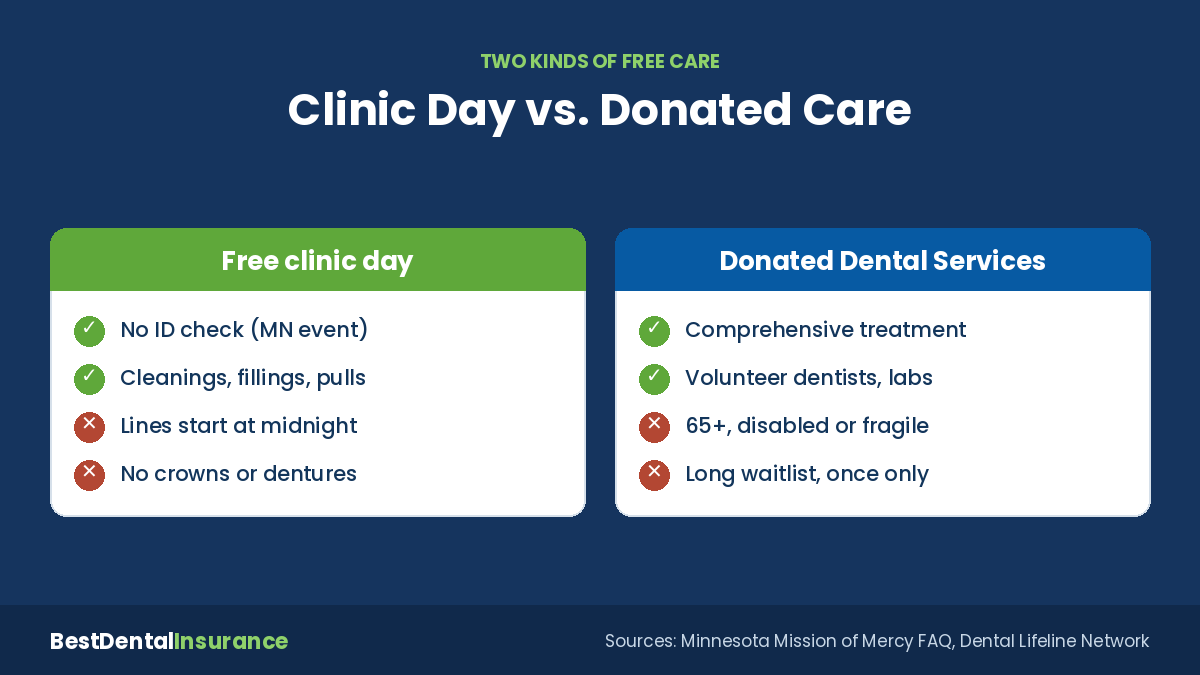
Volunteer events like state dental association Mission of Mercy clinics and Remote Area Medical pop-ups treat hundreds or thousands of people over two days at no charge, first come, first served.

1

Expect an overnight line. Minnesota’s Mission of Mercy says patients start arriving shortly after midnight for a 5:30 a.m. opening, and care stops when daily capacity is reached.

2

Plan one main fix. That event usually does one major service per person, such as several fillings or several extractions, and does not make crowns, dentures, implants or bridges or remove wisdom teeth.

3

Do not wait out an infection. Organizers tell anyone with swelling or fever to get care right away rather than hold out for the event date.

Dental Lifeline Network’s Donated Dental Services links people who are 65 or older, permanently disabled or medically fragile, and who cannot afford care, with volunteer dentists and labs. Care is comprehensive but not cosmetic, any dental benefits must be used up first, and help is given only once. Many counties are closed to new applicants.

Free local search: The 211 helpline run by United Way keeps local lists of free clinics, upcoming clinic days and charity dental programs. State health department oral health programs may list options too.

Find & Compare Plans Online

Speak with a licensed insurance agent

1-833-667-3396TTY 711

Mon-Fri: 8am-9pm ET

Medicaid and Medicare: What Public Programs Pay for Adult Teeth

Medicaid must cover dental care for enrollees under 21, but adult dental is each state’s choice. In states that expanded Medicaid, adults with income up to 138% of the poverty level can qualify, so a quick application may beat any waitlist.

Emergency-only states. Arizona, Florida, Georgia, Mississippi, Missouri, Nevada and Texas cover adults mainly for pain, infection or trauma.

Limited states. Nine states, including Arkansas, Indiana, Kentucky and Oklahoma, cover some routine care with tight caps or service lists.

Broader coverage. Most other states cover more, and a CareQuest survey rated 11 states plus DC as extensive. Utah added adult benefits in 2025.

Adults on Medicare face a different gap: Original Medicare does not cover most routine dental, while some Medicare Advantage plans add dental benefits that vary by plan. Options for people on a tight budget are on our Medicare dental plans for low-income seniors page.

Getting Covered So the Next Dental Bill Is Not a Scramble

Free care is built for people with no other way in, and it usually means waiting. Once the urgent tooth is handled, low-cost coverage makes the next checkup routine.

1

Start the clock now. Many individual plans cover cleanings early, often at 100%, but make you wait six to 12 months for fillings or bigger work. Buying while on a clinic waitlist gets that wait behind you sooner.

2

Compare yearly maximums. Annual caps often fall between $1,000 and $2,000, which matters if you need more than one large repair. Our individual dental insurance guide explains how to read them.

3

Look at no-wait plans. Some plans cover basic or major care from day one at a lower first-year percentage. See dental plans with no waiting period.

4

Weigh a discount plan. Discount plans are not insurance, but they cut fees at member dentists and often start within days. Our dental insurance vs. dental discount plans page compares the two.

If a large bill is already on the table, payment options are covered in our alternative ways to pay for major dental work guide.

Bottom Line

Free dental care for adults without insurance comes mainly from sliding-fee health centers, dental and hygiene schools, volunteer clinic days, donated-care programs and, in many states, Medicaid. Each one trades cost for time or eligibility limits, so use them for the problem in front of you and add an affordable dental or discount plan so routine care is covered next time.

See affordable dental plans available in your ZIP code

Free Dental Care for Adults Without Insurance — Frequently Asked Questions

➤ Can I get dental work for free if I have no income at all?

Often, yes. HRSA-funded health centers must give a full discount or charge only a nominal fee to patients at or below the poverty guideline, and with no income you may also qualify for Medicaid in your state.

➤ Will a community health center see me if I cannot pay anything today?

Yes. Federal rules for HRSA-funded health centers say no patient can be denied service because of inability to pay, though the center may set up a nominal fee or a payment arrangement.

➤ How much cheaper is a dental school than a regular dentist?

It varies. The University of Michigan’s student clinics charge about half of local private fees, but visits take longer and start with a screening.

➤ Can I get dentures or a crown at a free dental clinic day?

Usually not. Large events such as Minnesota’s Mission of Mercy focus on cleanings, fillings and extractions and do not make crowns, dentures, bridges or implants.

➤ Will the emergency room fix my tooth for free?

Not usually. An ER can treat a dangerous infection or severe pain, but it typically does not do fillings or root canals, and you are billed for the visit.

➤ How long does Donated Dental Services take?

Dental Lifeline Network says waits can run several months to a year or more, and coordinators cannot estimate them.

➤ Does Medicaid cover dental for adults?

It depends on the state. Some states cover cleanings, fillings and dentures, while seven, including Florida and Texas, cover adults mainly for emergencies.

➤ If I buy dental insurance today, can I use it right away?

Usually for checkups and cleanings. Fillings and larger work often carry a waiting period, while no-wait and discount plans can be used sooner, often at a lower first-year benefit.

Dental Insurance Quotes

Call a Licensed Agent Now

Compare dental plans for individuals, families and seniors from several insurance companies in one call.

☎ 1-833-667-3396

TTY users 711  |  Mon–Fri: 8am–9pm ET

No obligation to enroll

Find & Compare Plans Online

Speak with a licensed insurance agent

1-833-667-3396TTY 711

Mon-Fri: 8am-9pm ET

ZRN Health & Financial Services, LLC, a Texas limited liability company