




How Does Dental Insurance Work? From Monthly Premium to Paid Claim

Reviewed by Russell Noga, Licensed Insurance Broker — Last updated November 15, 2026

Dental insurance works by charging you a monthly premium, then paying a share of each covered dental bill, usually most or all of preventive care, a smaller share of fillings and a smaller share still of crowns, until the plan hits its yearly dollar cap. You pay the deductible, your coinsurance share and anything above the cap, and in-network dentists must accept the plan’s discounted fee.

2027 by the Numbers

98%

of individual Medicare Advantage enrollees are in plans offering some dental care (KFF, 2026)

$450 / $900

yearly out-of-pocket cap on exchange-certified stand-alone pediatric dental, one child / two or more (CMS, 2026 and 2027)

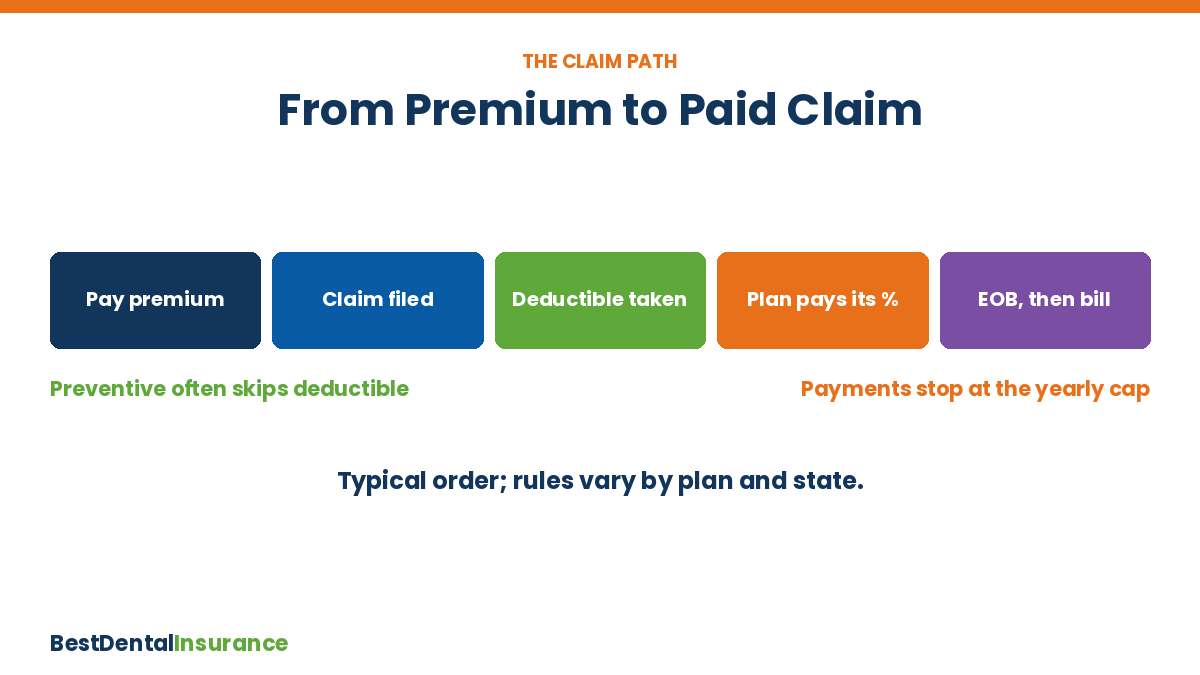
Every dental bill passes through the same chain: the plan confirms the service is covered, sets the allowed price, takes out any deductible, applies its percentage, and stops paying once your yearly limit is used.

Below, that chain is traced step by step with an illustrative claim and a sample year. Shopping without an employer? See individual dental insurance for where to buy.
Compare Dental Plans in Your Area

The Five Numbers That Run Every Dental Plan

How does dental insurance work: the path from premium to deductible, coinsurance, annual maximum and EOB

Every plan summary is built on the same few figures. Learn these five and most brochures become easy to read.

Premium. The fixed amount paid each month, whether or not you see a dentist. At work, the employer often pays part of it through payroll.

Deductible. What you pay each year before the plan starts sharing costs on basic and major care. Many plans skip the deductible for cleanings and checkups.

Coinsurance. The percentage split after the deductible. A plan paying 80% leaves you 20% of the allowed fee.

Annual maximum. The most the plan pays for you in a benefit year, often $1,000 to $2,000. Bills past that point are yours.

The fifth number is the waiting period: how long you hold the policy before certain services are covered. Waits are common for basic and major work on self-bought plans and rarer at work. Our dental insurance waiting periods guide covers typical lengths.

Dental Insurance Quotes

Call a Licensed Agent Now

Compare dental plans for individuals, families and seniors from several insurance companies in one call.

☎ 1-833-667-3396

TTY users 711  |  Mon–Fri: 8am–9pm ET

No obligation to enroll

Preventive, Basic and Major: How Your Plan Sorts Each Service

Plans sort procedures into classes, each with its own percentage. The common 100/80/50 pattern is an industry habit, not a rule: some plans pay 70% on basic care, some list root canals as major, and a few pay under 100% for checkups.

ClassTypical servicesShare the plan often paysDeductible usually applies?
PreventiveExams, cleanings, routine X-rays, fluoride for kidsOften 100%Often no
BasicFillings, simple extractions, sometimes root canalsOften 70%-80%Yes
MajorCrowns, bridges, dentures, sometimes implantsOften 50%Yes
OrthodonticsBraces, mostly for childrenOften 50% up to a lifetime cap, if covered at allVaries

General patterns only. Percentages, class placement and waiting periods vary by plan and state; check the plan’s summary of benefits.

Read this line first: The class a service falls into matters as much as the percentage. A root canal listed as basic at 80% costs far less out of pocket than the same root canal listed as major at 50%.

Following One Filling From the Chair to the EOB

1

The dentist files the claim. In-network offices usually send it electronically with procedure codes for each service.

2

The insurer sets the allowed fee. For an in-network dentist this is the negotiated price, which is often lower than the office’s full charge.

3

The plan applies its rules. It checks waiting periods, frequency limits and the deductible, then multiplies what is left by the coinsurance rate.

4

You get an Explanation of Benefits. The EOB is a statement, not a bill. The dentist bills you separately for the patient balance it shows.

EOB line (illustrative filling)AmountWhat it means
Billed charge$250The dentist’s full fee
Allowed amount$180The plan’s negotiated in-network price
Network write-off$70Removed by the dentist; you never pay it
Deductible applied$50Your first dollars this year
Plan pays (80% of $130)$104Coinsurance on the rest
Patient balance$76$50 deductible plus 20% of $130

Illustrative example with made-up round numbers to show the math. It is not a real price or a quote from any plan.

If the dentist’s bill does not match the EOB, ask the office to recheck it before paying.

How Networks Set the Price Your Claim Starts From

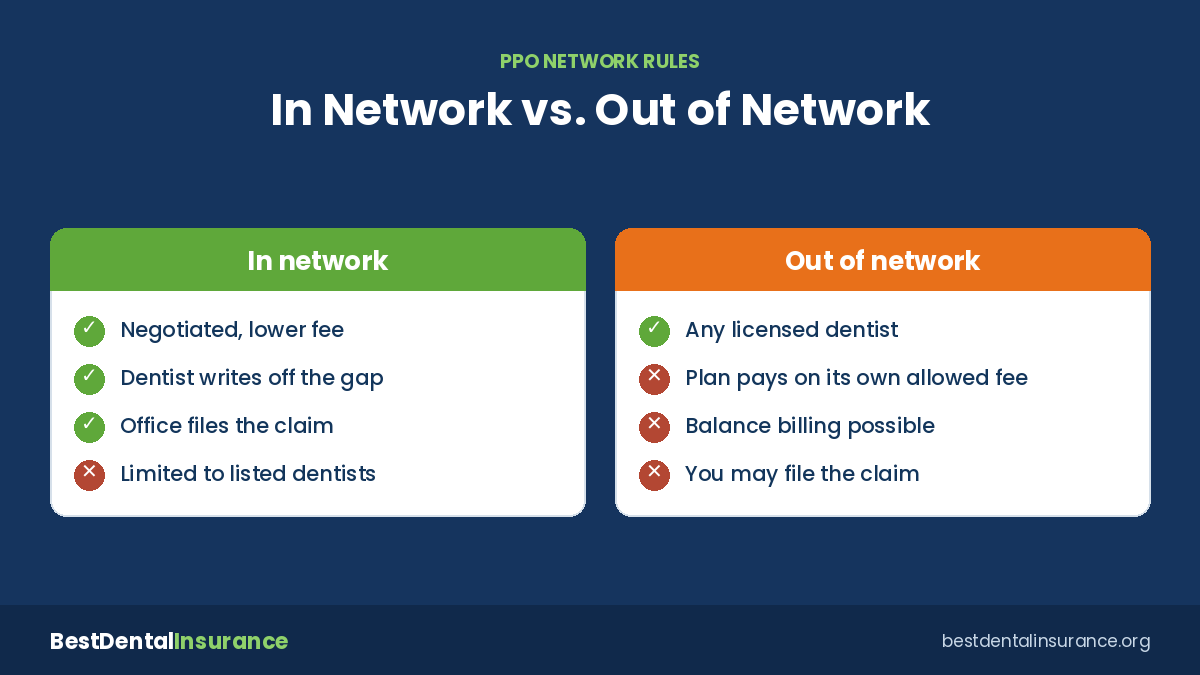
How dental insurance works in network vs out of network on a PPO plan

The network decides which dentists you can use and what price the math starts from.

PPO. Any licensed dentist, but in-network offices charge the discounted fee. Out of network, the plan pays its share of its own allowed amount.

HMO or DHMO. A dentist from a set list, fixed copays per service and often no annual maximum. Outside care is usually not covered except emergencies.

Indemnity. Any dentist, paid as a percentage of a reasonable-and-customary fee. More freedom, often higher premiums and more paperwork.

Out-of-network math: Balance billing is the gap between the dentist’s full fee and the plan’s allowed amount. In network, the dentist writes that gap off. Out of network on a PPO, the gap can be added to your share, so the same crown can cost noticeably more.

For a side-by-side look at premiums, copays and dentist choice, see dental HMO vs. PPO plans.

Find & Compare Plans Online

Speak with a licensed insurance agent

1-833-667-3396TTY 711

Mon-Fri: 8am-9pm ET

The Fine Print That Shrinks a Payout

Even a covered service can pay less than expected. These rules most often change the number on the EOB.

Frequency limits. Plans cap how often a service is paid, such as two cleanings a year or one set of bitewing X-rays a year. Crown replacement is often limited to once every five years on the same tooth.

Missing tooth clause. Some plans will not pay to replace a tooth that was lost before your coverage began. Other plans leave the clause out entirely, so it is worth checking before buying.

Yearly cap and waits. Once the annual maximum is used, the plan stops paying until the next benefit year, and new members may wait months for basic or major care.

Sample year (illustrative)Allowed feePlan paysYou payCap left of $1,500
Two cleanings and exams$300$300$0$1,200
One filling$180$104$76$1,096
One crown$1,100$550$550$546
Second crown$1,100$546$554$0

Illustrative example using an in-network PPO with a $50 deductible, 100/80/50 coinsurance and a $1,500 annual maximum. Not real prices; numbers are rounded to show how the cap runs out.

Before you book: Ask the office to send a pre-treatment estimate, also called a predetermination, for any work over a few hundred dollars. The insurer replies with what it expects to pay, which flags waiting periods, frequency limits and missing tooth exclusions before the drill starts. A list of what plans typically leave out is in common dental insurance exclusions.

Where Coverage Comes From and How to Pick a Plan

Through work. Lower premiums thanks to employer help, and often no waiting periods. Join at open enrollment or after a life event.

On your own. Individual and family plans are sold year-round in most states, often with waits on basic and major care.

On the ACA Marketplace. Children’s dental is an essential health benefit, built into a health plan or sold separately. Adult dental is not required.

Through Medicare Advantage. Original Medicare skips most routine dental, but many Medicare Advantage plans add it, usually with a yearly dollar limit.

With two plans, such as your own and a spouse’s, one pays first and the other may cover part of the rest, but never more than the bill. See our secondary dental insurance guide for the order rules.

1

Estimate next year’s care. List cleanings for each family member plus any fillings, crowns or braces your dentist has already mentioned.

2

Confirm your dentist’s network. Search the carrier’s directory by name and plan type, then confirm with the office.

3

Compare the cap to the work. If a crown or implant is coming, a higher annual maximum may matter more than a lower premium.

4

Check the waits and clauses. Read the waiting periods, frequency limits and any missing tooth rule before you enroll.

5

Add it up. Twelve months of premiums plus your expected share of care is the true yearly cost. See whether that beats paying cash in is dental insurance worth it.

Bottom Line

Dental insurance follows one path for every bill: allowed fee, deductible, coinsurance by class, then the yearly cap. Staying in network, getting a pre-treatment estimate for big work and matching the annual maximum to the care you expect are the three moves that keep the most money on the plan’s side of the EOB.

See dental plans & rates in your ZIP code

How Dental Insurance Works — Frequently Asked Questions

➤ Do I pay the dentist or does the insurance company pay first?

In network, the office usually files the claim, waits for the plan’s payment, then bills you the patient balance. Out-of-network dentists may ask for full payment and leave you to file for reimbursement.

➤ Is an Explanation of Benefits the same as a bill?

No. The EOB shows the charge, the allowed amount, what the plan paid and what you may owe. The dentist’s bill should match its patient balance.

➤ What does 100/80/50 mean on a dental plan?

Shorthand for a plan paying 100% of preventive, 80% of basic and 50% of major care after the deductible. Many plans follow it, but percentages and class placement vary.

➤ Does the deductible apply to cleanings?

On many plans it does not, so checkups are paid from the first visit. It usually applies to fillings, extractions and crowns.

➤ What happens when I reach my annual maximum?

The plan stops paying until the next benefit year, and you pay the full allowed fee for further care. The cap resets on the calendar year or your plan anniversary.

➤ Why did my plan pay less than its stated percentage?

Usual causes: an out-of-network fee above the allowed amount, a deductible taken from that claim, a frequency limit, or a lower-paying class. Remark codes on the EOB name the reason.

➤ What is a pre-treatment estimate?

A request the dentist sends before costly work, listing the planned procedure codes. The insurer replies with what it expects to pay, so you can plan your share first.

➤ Can I use dental insurance right away?

Preventive care is often covered from day one. Basic and major work may carry waiting periods, mainly on self-bought plans.

Dental Insurance Quotes

Call a Licensed Agent Now

Compare dental plans for individuals, families and seniors from several insurance companies in one call.

☎ 1-833-667-3396

TTY users 711  |  Mon–Fri: 8am–9pm ET

No obligation to enroll

Find & Compare Plans Online

Speak with a licensed insurance agent

1-833-667-3396TTY 711

Mon-Fri: 8am-9pm ET

ZRN Health & Financial Services, LLC, a Texas limited liability company