




Does Dental Insurance Cover Fillings? Tiers, White-Filling Rules and What You Pay

Reviewed by Russell Noga, Licensed Insurance Broker — Last updated November 20, 2026

Yes, dental insurance covers fillings on almost every plan, usually as a basic service paid at about 70% to 80% after the deductible once any waiting period ends. Some no-wait plans list fillings as major work at a lower share, and many plans pay a tooth-colored filling on a back tooth only at the cheaper silver-filling rate.

2027 by the Numbers

80%

filling payout after the deductible on Humana Complete Dental and Delta Dental PPO Premium (carriers)

25%

year-one filling payout on Spirit Dental Core PPO 1200, a major service (Spirit Dental)

$226

average composite filling fee, 2024 Synchrony study cited by Guardian

A cavity is the most common reason people use dental benefits beyond a cleaning. Fillings are covered on nearly every plan, but the payout swings widely, and three rules decide most of it: the tier the plan uses, any waiting period, and the filling material.

Below, four real plans are lined up and one filling bill is worked through line by line. For deductible and coinsurance basics, see how dental insurance works.
Compare Dental Plans That Cover Fillings

Where Fillings Land in a Plan's Coverage Tiers

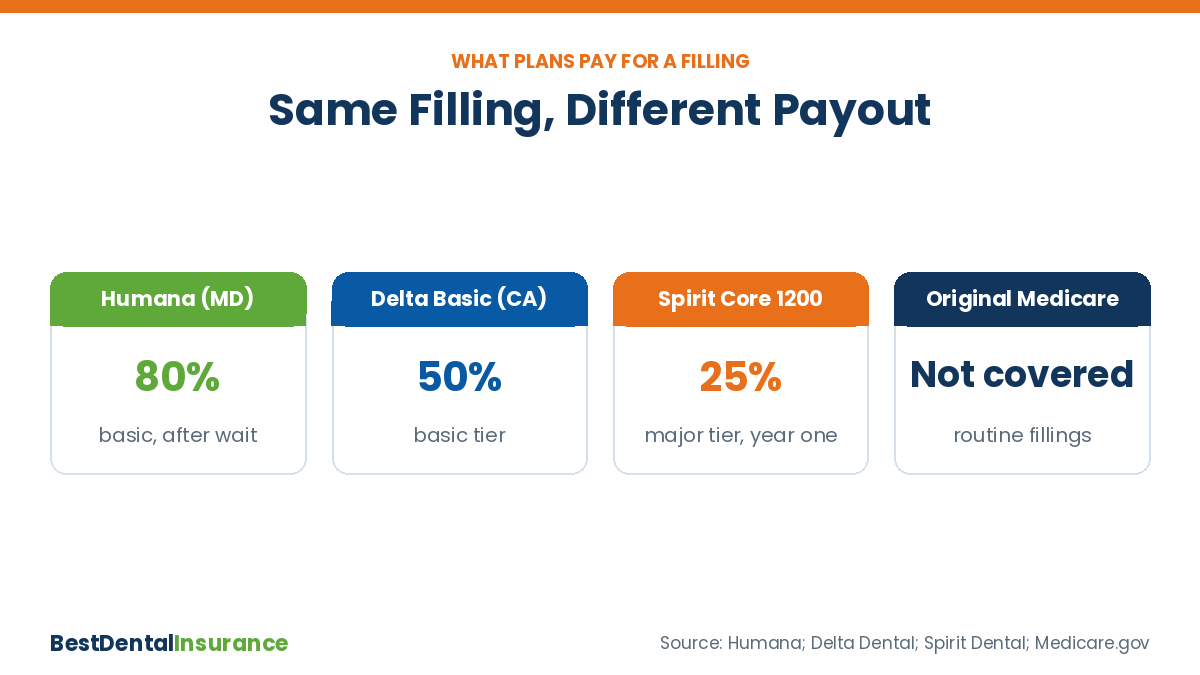
Does dental insurance cover fillings: payout shares on four plan types, from 80% to not covered

Most policies sort care into three classes: preventive (cleanings, exams), basic (fillings, simple extractions) and major (crowns, bridges, dentures). Fillings repair damage, so they rarely get preventive-level coverage of 100% with no deductible.

Basic tier (most plans). Often paid at 70% to 80% of the plan’s allowed fee after the deductible. Humana and Delta Dental’s individual PPO Premium plan both pay 80%.

Basic tier, leaner plans. Budget plans can pay far less. Delta Dental’s PPO Basic plan in California pays fillings at 50%.

Major tier (some no-wait plans). Plans that skip waiting periods sometimes move fillings into major work. Spirit Dental’s Core PPO 1200 pays 25% in year one and 50% after.

Two plans that both advertise no waiting period can pay a filling at very different rates, so read the benefit grid before comparing premiums. Plans built around immediate coverage are reviewed in dental plans with no waiting period.

Dental Insurance Quotes

Call a Licensed Agent Now

Compare dental plans for individuals, families and seniors from several insurance companies in one call.

☎ 1-833-667-3396

TTY users 711  |  Mon–Fri: 8am–9pm ET

No obligation to enroll

Four Plans, One Cavity: Filling Terms From the Fine Print

Carrier sales pages rarely mention filling limits. This table pulls them from each plan’s own summary, benefit grid or plan page.

PlanFilling tier and payoutWaiting periodReplacement limitWhite filling on a back tooth
Humana Complete Dental (Maryland)Basic, 80% after $50 deductible6 months; may be waived with prior coverageOne per tooth every 2 yearsPaid at the silver (amalgam) rate
Delta Dental PPO Premium (individual)Basic, 80% after $50 deductible6 monthsNot shown in plan summaryNot shown in plan summary
Delta Dental PPO Basic (California)Basic, 50% after $50 deductible6 months; waived with prior coverage1 per 25 months; no replacement by the same office within 25 monthsNo separate limit listed
Spirit Dental Core PPO 1200Major, 25% year 1, 50% from year 2NoneNot shown on plan pageNot shown on plan page

Sources: Humana Maryland Complete Dental summary; Delta Dental PPO Premium summary (dentalplans.com); Delta Dental PPO Basic 2026 matrix (California); Spirit Dental Core PPO page. In-network, checked Nov 2026. Varies by state.

What the table shows: The highest year-one payout belongs to a plan with a 6-month wait, and the no-wait plan pays the least in year one. Which fits depends on whether a cavity already needs work.

Timing Rules: Waits, Deductibles and Replacement Limits

Even on a plan that pays 80%, timing rules can cut the first filling claim to zero.

Waiting period. Six months for basic work is common, though it varies by plan and state. A filling done during the wait is generally not paid. Some carriers waive it with proof of recent prior coverage.

Deductible first. The deductible, often about $50 a person, usually applies to fillings even when cleanings are exempt.

Replacement clock. Many plans will not pay to redo a filling on the same tooth within a set time, such as Humana’s two years or Delta Dental California’s 25 months.

Same-office rule. Delta Dental’s filings treat a redo by the same office inside that window as part of the original fee.

The full rules on how long waits last and how to get credit for past coverage are in understanding dental insurance waiting periods.

Tooth-Colored Fillings on Back Teeth: The Downgrade Rule

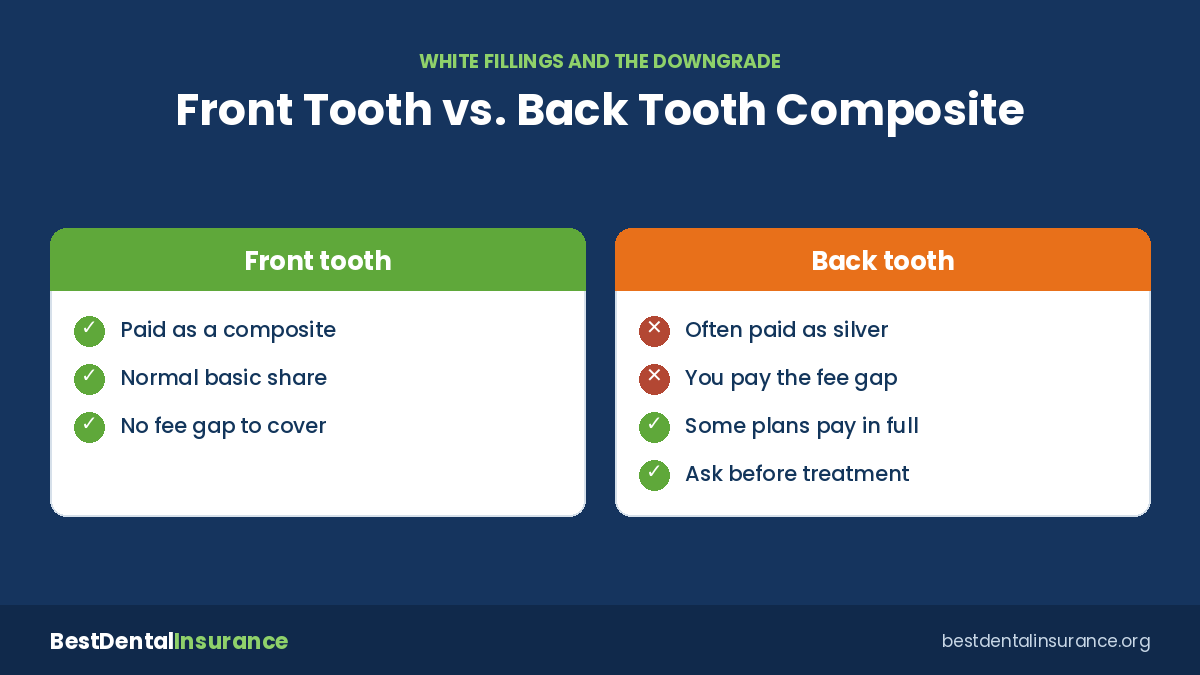
Tooth-colored filling coverage on front teeth vs. back teeth under an alternate benefit clause

Most fillings today are composite resin, which matches tooth color. Silver amalgam costs less, and many plans write that gap into the policy. The American Dental Association calls this a least expensive alternative treatment clause and names the back-tooth composite as one of its most common uses: the plan pays as if amalgam were placed, and the patient covers the price difference.

Humana’s Maryland Complete Dental plan covers composites on front teeth and applies an alternate benefit to composites on back teeth. Not every plan works this way. A 2023 distributor notice reported that UnitedHealthcare would cover back-tooth composites on its standard fully insured small-group plans from January 1, 2024.

Same filling, four situationsPlan paysYou pay
Plan pays composite as billed, deductible not yet met$160$90
Plan downgrades to an assumed $180 silver-filling fee$104$146
Filling done during a 6-month waiting period$0$250
No-wait plan, fillings in major tier at 25% in year one$50$200

Illustrative only, not a quote: a two-surface back-tooth composite with an assumed $250 network fee, $50 deductible and 80% basic payout. Real fees vary by plan, dentist and ZIP code.

The ADA’s own example is smaller: a $90 composite with a $60 amalgam allowance leaves the patient owing $42, not a $12 copayment.

Find & Compare Plans Online

Speak with a licensed insurance agent

1-833-667-3396TTY 711

Mon-Fri: 8am-9pm ET

Filling Coverage for Children, Adults and People on Medicare

The source of coverage changes with age, but the tier, wait and material rules above apply almost everywhere.

Who needs the fillingCommon coverage sourcesPoint to check
ChildrenA parent’s dental plan, ACA pediatric dental, Medicaid or CHIPPediatric dental is an ACA essential health benefit; adult dental is not
Working-age adultsEmployer plans, individual plans, exchange dental plansWaits and lower year-one payouts on many individual plans
People on MedicareSome Medicare Advantage plans; stand-alone dental plansMedicare.gov says Original Medicare does not cover fillings

Medicare Advantage dental benefits differ plan by plan, and some cap restorative work at a set dollar amount. See does Medicare cover dental work.

How to Shrink Your Share Before the Drill Starts

1

Ask for the code and surface count. Fillings are billed by material and number of surfaces. A three-surface filling costs more than a one-surface one.

2

Ask how the plan pays that material. For a back tooth, ask whether your plan applies an alternate benefit to composite and what the gap will be.

3

Check the calendar. If a small cavity can safely wait until the waiting period ends, the payout can go from zero to the full basic rate.

4

Stay in network. A network dentist cannot bill above the contract fee for a covered filling, apart from any material difference the plan allows.

5

Get an estimate for several fillings. A pre-treatment estimate shows how much of the yearly maximum will be left for bigger work.

When a filling is not enough: Deep decay may call for a crown or root canal, often major services with longer waits. See tooth crown cost with insurance before agreeing to the larger plan.

Bottom Line

Nearly every dental plan pays for fillings, but the tier, waiting period, deductible and any back-tooth composite downgrade set your real cost. Check those lines in the benefit summary and get an estimate before the appointment.

Check filling coverage on plans in your ZIP code

Dental Fillings Coverage — Frequently Asked Questions

➤ Are fillings basic or major dental work?

On most plans they are basic services, often paid at 70% to 80% after the deductible. Some no-wait plans, such as Spirit Dental’s Core PPO 1200, list them as major work.

➤ Will a new dental plan pay for a filling right away?

Only if the plan has no waiting period for fillings. Many plans wait about 6 months for basic work, and a filling done during the wait is usually not paid.

➤ Why did my plan pay less for my white filling than I expected?

Your plan likely has an alternate benefit clause. It pays a tooth-colored filling on a back tooth at the silver amalgam rate, and you pay the difference.

➤ How often will insurance pay to replace an old filling?

Many plans allow one replacement per tooth in a set period, commonly about two years. Delta Dental’s California Basic plan uses 25 months.

➤ Does the deductible apply to fillings?

Usually yes. Plans that waive the deductible for cleanings often still apply it to basic services.

➤ Does Medicare cover fillings?

Medicare.gov says Original Medicare does not cover routine fillings. Some Medicare Advantage plans include dental benefits for fillings, with limits that vary by plan.

➤ What does a filling cost without insurance?

Guardian cites an average of $226 for a composite filling from a 2024 Synchrony study, and Humana estimates $199 to $333 for an adult filling in Orlando, Florida. Size and material change the price.

➤ Can a network dentist charge me more than the plan’s fee for a filling?

Generally not for the covered service, since network dentists accept the contract fee. The exception is a material downgrade, where you can owe the gap between composite and amalgam fees.

Dental Insurance Quotes

Call a Licensed Agent Now

Compare dental plans for individuals, families and seniors from several insurance companies in one call.

☎ 1-833-667-3396

TTY users 711  |  Mon–Fri: 8am–9pm ET

No obligation to enroll

Find & Compare Plans Online

Speak with a licensed insurance agent

1-833-667-3396TTY 711

Mon-Fri: 8am-9pm ET

ZRN Health & Financial Services, LLC, a Texas limited liability company