




Tooth Crown Cost With Insurance: Prices by Material and What Plans Pay

Reviewed by Russell Noga, Licensed Insurance Broker — Last updated October 29, 2026

With dental insurance, many people pay about half the cost of a tooth crown, roughly $550 to $1,000 plus the deductible on a typical $1,100 to $2,000 crown. Most plans cover crowns as a major service at about 50% after the deductible, up to the plan’s annual maximum.

2027 by the Numbers

$1,100-$2,000

average out-of-network cost of a permanent crown (Delta Dental)

About 50%

share many plans pay for a crown after the deductible (GoodRx)

6 or 12 mo

common waiting period for major care like crowns (Humana)

A dental crown is a tooth-shaped cap that covers a cracked, weak or badly decayed tooth. It is also common after a root canal. Crowns protect the tooth so you can chew normally, but they are one of the more expensive treatments a dentist does. That makes it smart to know what your plan pays before you sit in the chair, whether you are buying coverage for yourself, your family or a parent.

This guide covers crown prices by material, how insurance usually treats crowns, waiting periods, downgrade rules and simple ways to cut your bill. If you also need a root canal, see whether Delta Dental covers root canals, and for replacing a missing tooth, see our guide to dental bridge cost with insurance.
Compare Dental Plans That Cover Crowns

Tooth Crown Cost by Material

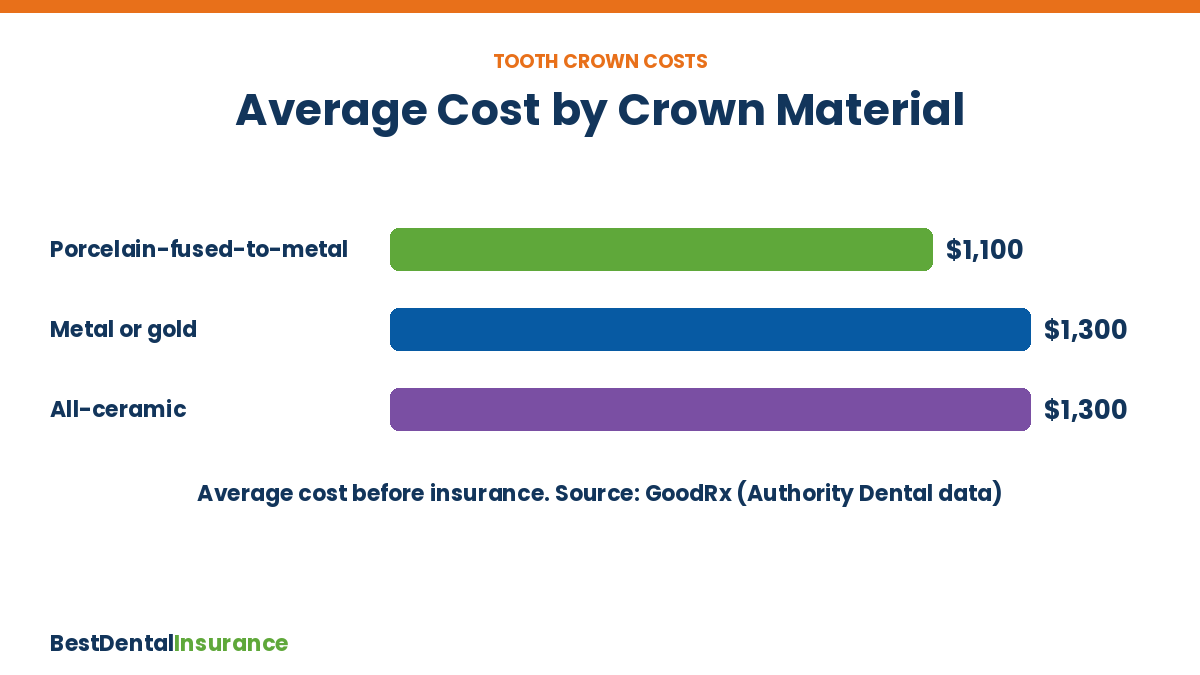
Tooth crown cost with insurance chart showing average crown cost by material before insurance

The material your dentist uses is one of the biggest factors in the price. Your area, your dentist’s fees and whether you stay in network matter too. Delta Dental puts the average out-of-network cost of a permanent crown at about $1,100 to $2,000, and that price usually includes the temporary crown, lab costs and the dentist’s time.

Crown materialGood to knowTypical cost without insurance
Porcelain-fused-to-metal (PFM)Metal base with a tooth-colored outer layer; strong and widely used$800 to $2,400 (average about $1,100)
Metal (gold or base-metal alloys)Very durable; often used on back teeth; gold costs more than base metals$900 to $2,500 (average about $1,300)
All-ceramic or porcelainMost natural look; popular for front teeth$1,000 to $2,500 (average about $1,300)
ZirconiaStrong ceramic that can look natural; often priced like other ceramic crownsOften in the all-ceramic range

Source: GoodRx dental crown cost guide (citing Authority Dental) for prices before insurance. GoodRx groups zirconia with all-ceramic crowns and does not list a separate zirconia price. Your dentist’s fee may be higher or lower.

Crowns placed for looks alone are usually treated as cosmetic, and most plans do not cover them. A crown your dentist says is needed to save a damaged tooth is far more likely to be covered.

Dental Insurance Quotes

Call a Licensed Agent Now

Compare dental plans for individuals, families and seniors from several insurance companies in one call.

☎ 1-833-667-3396

TTY users 711  |  Mon–Fri: 8am–9pm ET

No obligation to enroll

How Dental Insurance Covers a Tooth Crown

Most dental plans group crowns with bridges, dentures and root canals as major services. Major services are often paid at about 50% after you meet your deductible. Plans with only preventive or basic coverage may not pay for crowns at all, so check the plan summary before you buy.

About 50% coinsurance. Many plans pay about half of the plan’s allowed fee for a crown, and you pay the rest.

Deductible first. You usually pay a yearly deductible, often around $50 to $100, before the plan starts to share the cost.

Annual maximum. Many plans cap yearly benefits at about $1,000 to $2,500, and one crown can use a big part of that.

Replacement limits. Many plans pay for a new crown on the same tooth only once every five years or more.

Your plan’s yearly cap matters a lot if you need more than one crown or other big work in the same year. Our guide to the best dental insurance for major dental work compares plan features that matter for crowns.

Waiting Periods, Downgrades and Other Plan Rules

A few plan rules can change what you pay for a crown. The first is the waiting period. Humana notes that most dental insurers use a waiting period of 6 or 12 months for major care, though some individual plans are shorter. A new insurer may waive the wait if you switch plans without a gap in coverage.

Watch for this: Many plans have an alternate benefit, or downgrade, clause. On back teeth, the plan may pay only what it would pay for a lower-cost metal crown, even if you choose porcelain. You can still get the porcelain crown, but you pay the price difference on top of your normal share.

Frequency limits. If your old crown is newer than the plan’s limit, often five years or more, the plan may not pay to replace it.

Cosmetic exclusions. Crowns done only to improve how a tooth looks are usually not covered.

Missing tooth clause. Some plans won’t pay to replace a tooth lost before coverage began. This affects bridges and implant crowns more than a crown on your own tooth.

Learn more about how long you may wait in our guide to dental insurance waiting periods.

Tooth Crown Cost With Insurance: Example Math

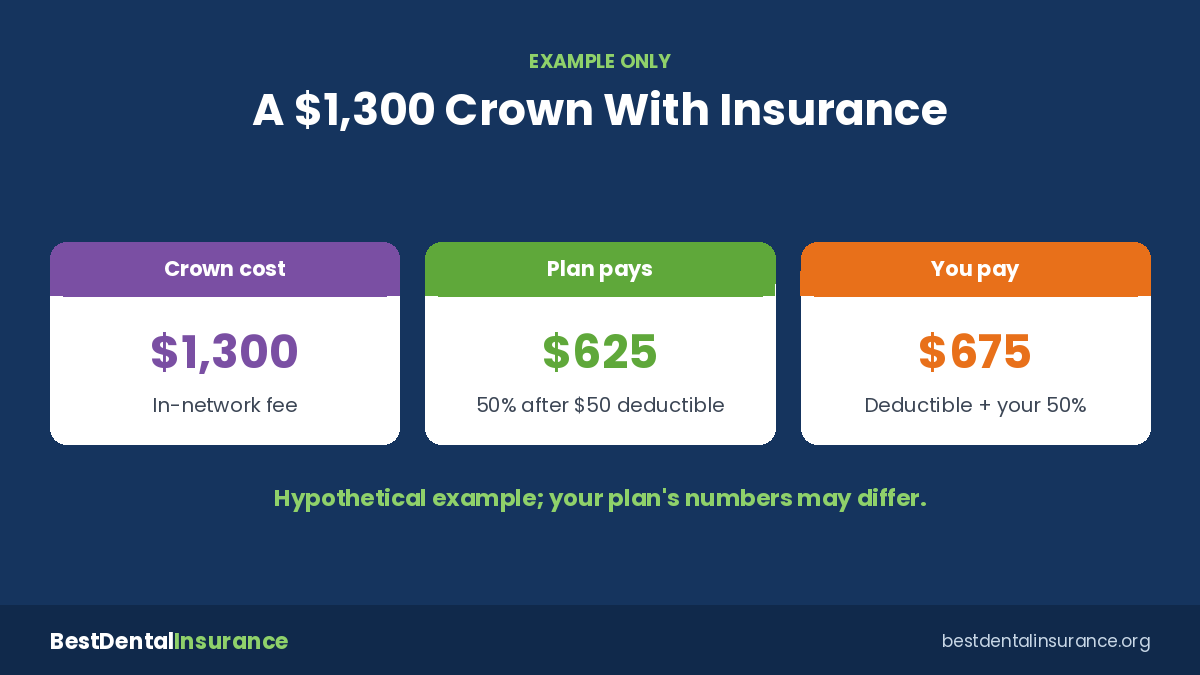
Tooth crown cost with insurance example with a 50 percent plan and a 50 dollar deductible

Here is a simple example to show how the numbers add up. It is only an example and does not reflect any specific plan. It assumes a $1,300 porcelain crown, a $50 deductible, 50% coverage for major services, no waiting period left to serve and plenty of annual maximum left.

1

Start with the bill. Your in-network dentist charges $1,300 for a porcelain crown.

2

Pay the deductible. You pay the first $50, which leaves $1,250 to share.

3

Apply 50% coinsurance. The plan pays $625 and you pay $625.

4

Add up your share. You pay $50 plus $625, for a total of $675.

ExamplePlan paysYou pay
Porcelain crown covered at 50%$625$675
Same crown on a molar with a downgrade to an $800 metal crown allowance$375 (50% of $800 minus the $50 deductible)$925
No insurance, full price$0$1,300

Hypothetical example for illustration only. Your plan’s allowed fees, deductible, coinsurance and annual maximum may differ.

A pre-treatment estimate from your dentist is the best way to see your real share before work starts.

Find & Compare Plans Online

Speak with a licensed insurance agent

1-833-667-3396TTY 711

Mon-Fri: 8am-9pm ET

Crowns for Seniors and People on Medicare

Crowns are common at every age, but coverage works differently once you are on Medicare. Original Medicare generally does not cover routine dental care such as crowns, fillings or dentures. It only helps in limited cases tied to a hospital stay or certain medical treatments.

Medicare Advantage. Many Medicare Advantage plans include dental benefits. Some cover only cleanings and exams, while others pay a share of crowns. Benefits and yearly caps vary by plan.

Stand-alone dental plans. Seniors can buy an individual dental plan just like younger adults. Look for major-service coverage and check the waiting period.

Medicaid. Medicaid covers medically needed crowns for children. Adult dental coverage varies by state.

Working-age adults with employer coverage often face shorter waits or none, so check your group plan first.

How to Lower Your Tooth Crown Cost

1

Ask for a pre-treatment estimate. Your dentist sends the plan to your insurer, so you see what is covered and your share before treatment.

2

Stay in network. Network dentists charge plan-negotiated fees, which lowers the total bill and the half you pay.

3

Ask about material. On a back tooth, a metal or PFM crown may cost less and avoid a large downgrade gap.

4

Plan around your annual maximum. If you need several crowns, ask your dentist whether it is safe to spread the work across two plan years.

Broker tip: If you need a crown soon and can’t wait out a waiting period, a dental discount plan may help. DentalPlans.com says savings plans range from 10% to 60% off at participating dentists, with no annual maximum and no waiting periods in most cases. They are not insurance, so you pay the discounted fee yourself.

HSA or FSA funds may also help pay your share. Compare options in our guides to dental insurance vs dental discount plans and the average cost for dental insurance.

Bottom Line

A tooth crown often costs about $800 to $2,500 without insurance, and a plan that covers major services usually pays about half after the deductible, up to its annual maximum. Check the waiting period, downgrade clause and replacement limit, and get a pre-treatment estimate before you start.

Related: does dental insurance cover fillings before decay needs a crown How four plans tier and limit fillings, the back-tooth white-filling downgrade, and a worked cost example.

See dental plans & rates in your ZIP code

Tooth Crown Cost With Insurance — Frequently Asked Questions

➤ How much does a tooth crown cost with insurance?

Many plans pay about 50% of a crown after the deductible, up to the annual maximum. For example, on a $1,300 crown with a $50 deductible, you would pay about $675. Your real cost depends on your plan and dentist.

➤ How much does a crown cost without insurance?

GoodRx lists porcelain-fused-to-metal crowns at about $800 to $2,400, metal crowns at about $900 to $2,500 and all-ceramic crowns at about $1,000 to $2,500. Delta Dental puts the average out-of-network crown at about $1,100 to $2,000.

➤ Is a crown a major or basic service?

Most plans treat crowns as a major service, often paid at about 50%. Some plans list certain crowns, such as stainless steel crowns, as basic care.

➤ Is there a waiting period for crowns?

Often, yes. Many plans have a 6- or 12-month waiting period for major care. Some insurers waive it if you switch plans without a gap in coverage.

➤ Why did my insurance pay less for my porcelain crown?

Your plan may have an alternate benefit, or downgrade, clause. On back teeth, it may pay only what it would for a lower-cost metal crown, and you pay the difference.

➤ How often will insurance pay to replace a crown?

Many plans pay to replace a crown on the same tooth only once every five years or more. Check your plan’s frequency limits before replacing a crown.

➤ Does Medicare cover dental crowns?

Original Medicare generally does not cover routine crowns. Many Medicare Advantage plans include dental benefits, and some pay a share of crowns, but coverage varies by plan.

➤ Can I get a crown with no waiting period?

Some dental plans have short or no waits for major care, and dental discount plans usually have no waiting period. A discount plan is not insurance, but it can lower the fee you pay.

Dental Insurance Quotes

Call a Licensed Agent Now

Compare dental plans for individuals, families and seniors from several insurance companies in one call.

☎ 1-833-667-3396

TTY users 711  |  Mon–Fri: 8am–9pm ET

No obligation to enroll

Find & Compare Plans Online

Speak with a licensed insurance agent

1-833-667-3396TTY 711

Mon-Fri: 8am-9pm ET

ZRN Health & Financial Services, LLC, a Texas limited liability company